
What's Happening?
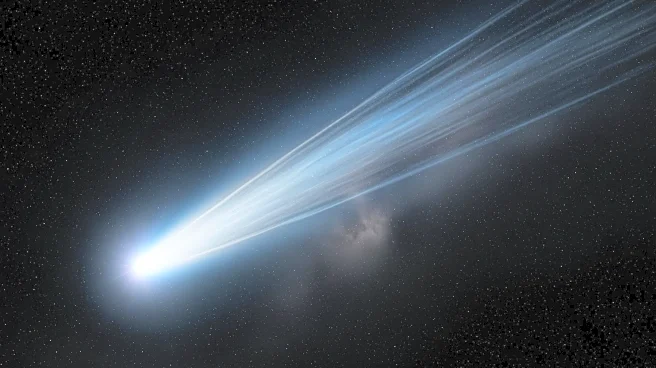
The Hubble Space Telescope has captured new images of the interstellar comet 3I/ATLAS as it nears its closest approach to Earth. This comet, originating from outside our solar system, was first observed
in July and has been the focus of numerous missions due to its unique trajectory and composition. On November 30, Hubble's Wide Field Camera 3 provided a detailed view of the comet, which is currently 178 million miles from Earth. The European Space Agency's Jupiter Icy Moons Explorer also captured images of the comet, revealing two tails and a glowing halo of gas. The comet will come within 167 million miles of Earth on December 19, posing no risk to the planet.
Why It's Important?
The observation of 3I/ATLAS is significant as it is only the third interstellar object observed passing through our solar system. These observations provide valuable insights into the composition and behavior of such objects, which can enhance our understanding of the universe beyond our solar system. The data collected from these missions could offer clues about the origins of interstellar objects and contribute to the broader field of astronomy. The comet's approach also presents an opportunity for scientists to study its sublimating materials, which can inform theories about the formation of celestial bodies.
What's Next?
The comet is expected to remain visible to telescopes and space missions for several months before exiting the solar system. The European Space Agency's Juice mission will continue to send back data, including high-resolution images and composition data, which are expected to arrive between February 18 and 20. This data will further aid in understanding the comet's properties and origins. As the comet approaches, astronomers will continue to monitor its trajectory and behavior, potentially leading to new discoveries about interstellar objects.