
What's Happening?
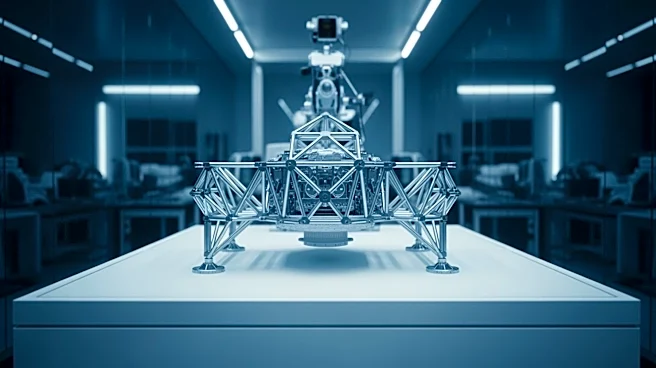
The ExoMars 2028 mission, a collaborative effort led by the European Space Agency (ESA) with contributions from NASA, has reached a significant milestone. The structural models of the mission's core elements
have been integrated in Turin and transferred to Cannes for the first phase of testing and verification. This mission aims to search for signs of life beneath the Martian surface and to better understand the planet's environment. The structural models are crucial for validating the mechanical design before the completion of the flight hardware. They will undergo extensive testing, including vibration, acoustic, shock, and separation tests, to ensure the spacecraft can withstand the extreme conditions of the mission.
Why It's Important?
The ExoMars 2028 mission represents a major step forward in planetary exploration, particularly in the search for life on Mars. By testing the structural models, engineers can ensure the reliability and safety of the mission, reducing risks associated with deep space exploration. The mission's success could provide valuable insights into the Martian environment and potentially uncover evidence of past life, which would have profound implications for our understanding of life beyond Earth. Additionally, the mission strengthens international collaboration in space exploration, showcasing the capabilities of European and American space agencies.
What's Next?
Following the completion of the structural model tests, the Proto-Flight Model (PFM), which includes the fully integrated flight hardware, will undergo its dedicated test sequence. This will include thermal vacuum, vibration, acoustic, and electromagnetic compatibility testing, as well as dynamic balancing. These steps are essential to prepare for the mission's scheduled launch in 2028 and its expected arrival on Mars in 2030. The mission will continue to rely on strong industrial cooperation, with various companies contributing key technologies and systems to ensure its success.