
What's Happening?
The interstellar comet 3I/ATLAS is set to pass by Earth on December 19, maintaining a safe distance of about 170 million miles. This event provides astronomers with a rare chance to study a comet from
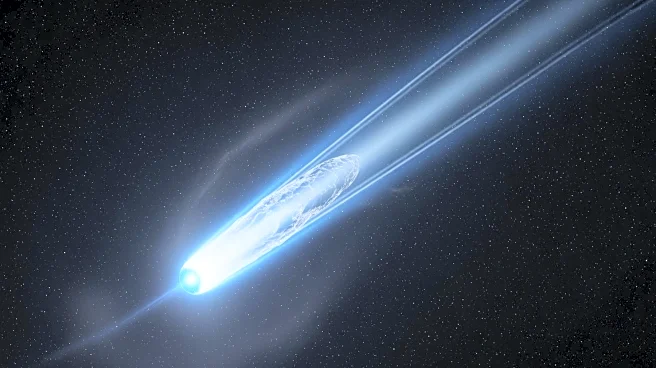
outside our solar system. Discovered in July, 3I/ATLAS is only the third known interstellar object to visit our solar system. NASA's Hubble Space Telescope and ESA's JUICE spacecraft have captured images of the comet, revealing its active state as it approaches the sun. The comet's icy core is surrounded by a cloud of dust, and its activity has increased due to solar heating.
Why It's Important?
The passage of 3I/ATLAS offers a significant opportunity for scientific research, as interstellar comets are seldom observed. Studying such objects can provide insights into the composition and dynamics of celestial bodies from other star systems, enhancing our understanding of the universe. The safe distance of the comet ensures there is no risk to Earth, allowing scientists to focus on gathering data. This research could lead to new discoveries about the formation and behavior of comets, contributing to the broader field of astronomy.
What's Next?
After its flyby on December 19, 3I/ATLAS will continue its trajectory through the solar system, passing near Jupiter in 2026. This will provide another opportunity for observation before the comet exits the solar system. Scientists will analyze data from the Hubble Space Telescope and ESA's JUICE spacecraft to learn more about the comet's properties and origins. The study of 3I/ATLAS will likely inform future research on interstellar objects and their interactions with our solar system.