





What's Happening?
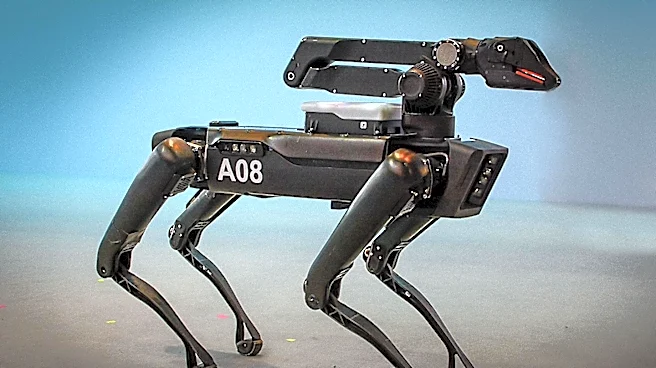
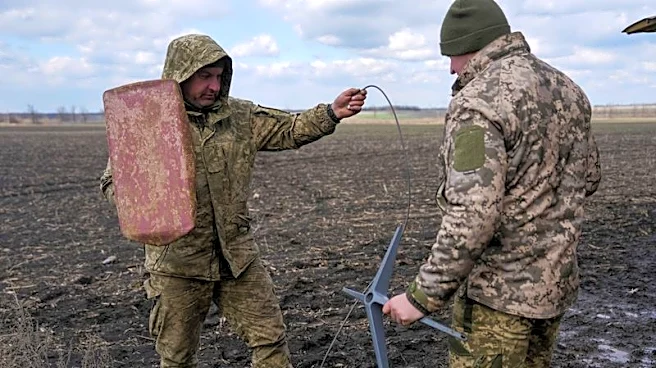
The Ukrainian military is undergoing a significant transformation with the widespread deployment of uncrewed ground vehicles (UGVs), leading to new roles for soldiers. These robots are increasingly performing dangerous tasks such as hauling ammunition,
delivering food, carrying weapons, and evacuating wounded troops, thereby reducing the exposure of human soldiers to frontline dangers. The Ukrainian Defense Ministry reported a substantial increase in robotic missions, from approximately 7,500 in January to 25,000 in August 2026. This shift has created new jobs for soldiers, who are now engaged in operating, modifying, and planning missions for these machines from behind computer screens. While infantrymen remain essential for assault operations and in environments where robots are less effective, the war is becoming increasingly robotic, demanding new skills in programming and engineering from military personnel.
Why It's Important?
This evolution in Ukrainian warfare is critical for several reasons. Firstly, it significantly enhances soldier safety by minimizing human presence in high-risk 'kill zones,' potentially reducing casualties and preserving military personnel. Secondly, it represents a strategic adaptation to the modern battlefield, where pervasive aerial reconnaissance makes traditional logistics and movement extremely dangerous. The shift towards robotic operations allows for more efficient and safer execution of critical tasks. Thirdly, it drives innovation within Ukraine's defense industry, fostering the development and production of advanced robotic systems. This transformation also necessitates a re-skilling of the military workforce, emphasizing technical and cognitive abilities over purely physical strength, which could have long-term implications for military training and recruitment strategies globally. The success of this robotic integration could serve as a blueprint for future conflicts.
What's Next?
The trend of increasing robot deployment is expected to continue, with a focus on developing more sophisticated, autonomous, and resilient UGVs. Ukrainian soldiers will increasingly require training in robotics, programming, and advanced operational planning. The ongoing technological arms race means that both sides will continue to develop and counter robotic systems, leading to rapid innovation in areas like anti-shrapnel armor, communication equipment, and electronic warfare. The Ukrainian defense industry, with companies like Ratel Robotics, will likely see continued growth and investment. While robots will augment human capabilities, infantrymen will remain crucial for complex combat scenarios, and the military will need to balance human and robotic integration effectively. The long-term goal is to execute a wide range of tasks without putting human lives in harm's way, requiring a continuous supply of these systems.
Beyond the Headlines
The 'robot war' in Ukraine raises profound ethical and societal questions about the future of human involvement in conflict. While saving lives is a clear benefit, the increasing reliance on autonomous systems could lead to a detachment from the human cost of war, potentially lowering the threshold for engagement. There are also concerns about the moral responsibility for actions taken by autonomous weapons and the potential for unintended consequences. Socially, this shift could alter the perception of military service, attracting individuals with technical skills rather than traditional combat profiles. Economically, it creates a new sector for defense technology and robotics, driving innovation and investment. However, it also highlights the growing disparity in military capabilities between nations that can afford and develop such technologies and those that cannot, potentially reshaping global power dynamics.