






What's Happening?
Researchers from CSIRO, Australia’s national science agency, and the University of Melbourne have made a breakthrough in predicting El Niño-Southern Oscillation (ENSO) events, including both El Niño and La Niña, up to a year in advance. The study, published
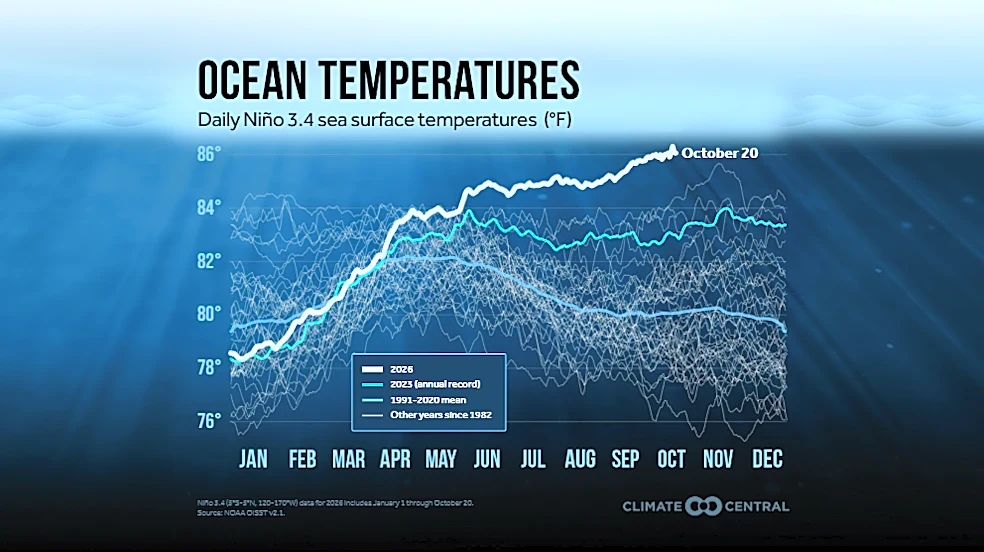
in the journal Science Advances, analyzed over 7,500 historical ENSO forecasts from climate models across nine countries. They discovered that the initial state of the Pacific Ocean—whether it is in an El Niño, La Niña, or neutral phase—significantly impacts the reliability of long-range forecasts. Specifically, forecasts initiated during La Niña conditions consistently performed well in predicting ENSO events a year ahead, while those starting from neutral conditions were far less reliable. This finding provides a new method for assessing confidence in long-range climate forecasts, potentially allowing communities and decision-makers more time to prepare for extreme weather events associated with these climate patterns. Dr. Nandini Ramesh, lead author and senior research scientist at CSIRO, highlighted that this information can be used to identify more reliable forecasts and issue earlier warnings to the public.
Why It's Important?
This scientific advancement holds significant importance for the United States, particularly for regions prone to extreme weather events influenced by ENSO. Improved long-range predictability of El Niño and La Niña can provide critical lead time for U.S. industries, public policy, and society to prepare for potential droughts, floods, and other climate impacts. For instance, agricultural sectors can adjust planting schedules and irrigation practices, while water management agencies can better plan for water storage and distribution. Coastal communities, especially in California, which experience significant rainfall variability due to ENSO, can enhance their preparedness for potential coastal flooding and storm damage. The ability to issue earlier warnings could mitigate economic losses, protect infrastructure, and save lives by allowing for more effective disaster response and resource allocation. This breakthrough could also influence public policy by enabling government agencies to implement proactive measures rather than reactive ones, fostering greater resilience against climate variability.
What's Next?
While the research offers promising insights, the team is still a few steps away from integrating these findings into the operational forecasting models used by agencies. The next phase will involve further research to apply these insights to existing models and refine their accuracy. This could lead to the development of more robust early-warning systems for El Niño and La Niña events. Additionally, the study suggests that different forecasting approaches, such as machine learning and statistical models, might be more effective for predictions starting from neutral conditions, indicating a potential area for future research and development. The ultimate goal is to provide more confident and earlier warnings, allowing for better preparation and adaptation strategies across various sectors in the U.S. and globally.
Beyond the Headlines
The deeper implications of this research extend to the ethical and societal responsibilities associated with climate prediction. As forecasting capabilities improve, there will be increased pressure on governments and organizations to act on these early warnings, raising questions about resource allocation, infrastructure investment, and equitable access to protective measures. The study also underscores the ongoing challenge of climate change, as El Niño and La Niña events are intensified by global warming, making their impacts more severe. This research, while focused on prediction, implicitly highlights the need for continued efforts in climate mitigation to reduce the overall severity of these natural phenomena. The ability to predict these events with greater accuracy could also foster international collaboration in climate science and disaster preparedness, as ENSO patterns have global repercussions.