



What's Happening?
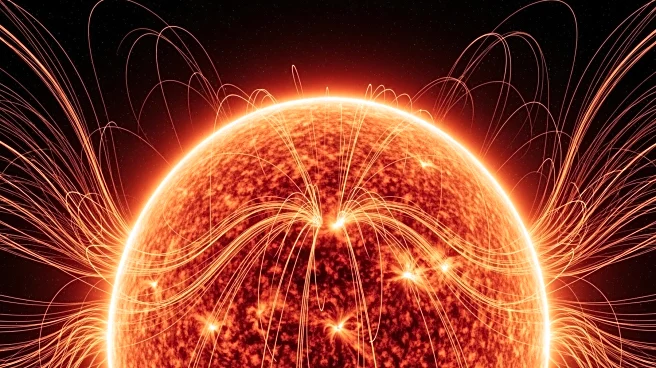
Astronomers have successfully mapped the Sun's outer magnetic boundary, known as the Alfvén surface, which plays a critical role in the generation of the solar wind. This boundary marks the point where the speed of solar material exceeds the speed of magnetic waves,
allowing it to escape into space. The mapping was achieved using data from NASA's Parker Solar Probe and the European Space Agency's Solar Orbiter. The study reveals that the Alfvén surface is highly dynamic, shifting in response to the Sun's activity cycles, and is more complex than previously thought.
Why It's Important?
Mapping the Alfvén surface is crucial for understanding space weather, which affects satellite operations, communication systems, and power grids on Earth. The solar wind, which originates from this boundary, influences the entire heliosphere and can trigger geomagnetic storms. By understanding the dynamics of the Alfvén surface, scientists can improve predictions of space weather events and their potential impacts on Earth. This research also contributes to our knowledge of solar physics and the mechanisms driving the Sun's activity.
What's Next?
Further research will focus on monitoring the Alfvén surface over a complete solar cycle to better understand its behavior and influence on the solar wind. Continued observations from Parker Solar Probe and other missions will provide more data to refine models of the Sun's magnetic environment. This ongoing research will enhance our ability to predict space weather and mitigate its effects on technological systems.