






What's Happening?
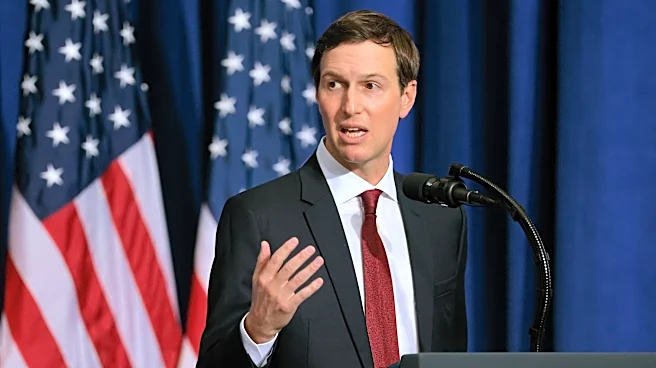
Jared Kushner, the U.S. President’s Special Representative, announced that negotiations with Ukraine, NATO, and European partners in Brussels regarding security guarantees for Kyiv have been productive and substantive. Writing on social media platform
X, Kushner stated that the U.S. is working to find practical solutions to end the war and establish lasting peace by addressing security concerns through mutually agreed-upon arrangements to reduce future conflict risks. He confirmed that the first trilateral peace talks between Ukraine, the U.S., and Russia since February are scheduled for next week in Abu Dhabi. According to Kushner, the U.S. is collaborating with both sides to develop substantive proposals to ensure these talks are meaningful and productive. President Trump has prioritized achieving peace, and the focus is on the detailed work required to achieve a comprehensive and long-lasting agreement.
Why It's Important?
These developments are significant for U.S. foreign policy and international relations, particularly concerning the ongoing conflict in Ukraine. The U.S. engagement in facilitating security guarantees and trilateral peace talks underscores its commitment to resolving the conflict and stabilizing European security. A successful outcome could reduce geopolitical tensions, potentially leading to a more stable global economic environment. For Ukraine, these negotiations are crucial for its long-term security and sovereignty, while for Russia, they offer a pathway to de-escalation and potential reintegration into international diplomatic frameworks. The involvement of NATO and European partners highlights a unified approach to regional security, aiming to prevent future conflicts and uphold international law. The U.S. role as a mediator positions it as a key player in shaping the post-conflict order in Eastern Europe.
What's Next?
The immediate next step involves the trilateral peace talks between Ukraine, the U.S., and Russia, scheduled for next week in Abu Dhabi. These talks are expected to focus on post-war security, de-escalation, and humanitarian issues. Kushner outlined five main objectives for these discussions: ongoing security consultations, reliable crisis communications, greater military transparency, reciprocal measures to reduce escalation risks, and a stable framework for long-term European security. The U.S. will continue consultations in the Shell Bay format with Ukraine, NATO, the European Union, and European partners, and will engage the Russian side within the peace process. If progress is made, a broader multilateral format with direct participation from European partners will be sought. European countries will not participate in the initial trilateral technical talks.
Beyond the Headlines
The emphasis on respecting the sovereignty, territorial integrity, and independent decision-making of each nation, as stated by Kushner, is a critical underlying principle that could shape future international agreements. This approach aims to ensure that any security arrangements do not infringe upon national autonomy, with NATO remaining central to Europe’s collective defense. The initiative seeks to build upon existing institutions and commitments, rather than creating entirely new frameworks, which could foster greater stability and acceptance among stakeholders. The long-term implications include the potential for a re-evaluation of European security architecture, especially after more than 30 years of attempts to build a stable framework between Europe and Russia. The U.S. mediation efforts could set a precedent for resolving complex international disputes through sustained diplomatic engagement and a focus on practical, mutually beneficial arrangements.