





What's Happening?
An international team of researchers, including Professor Gilbert Weinstein of Ariel University, has definitively answered a long-standing question in physics: whether multiple black holes can exist in a perfectly static equilibrium. The conclusive answer,
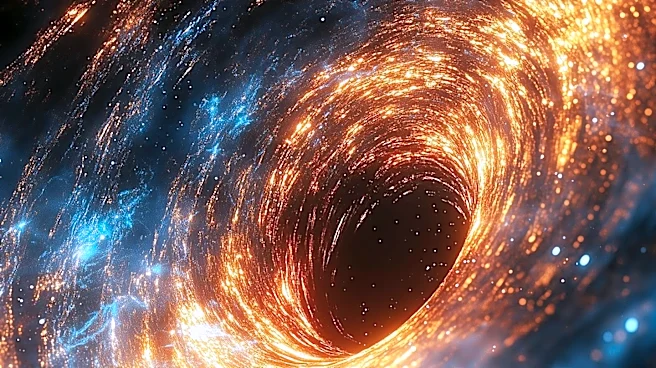
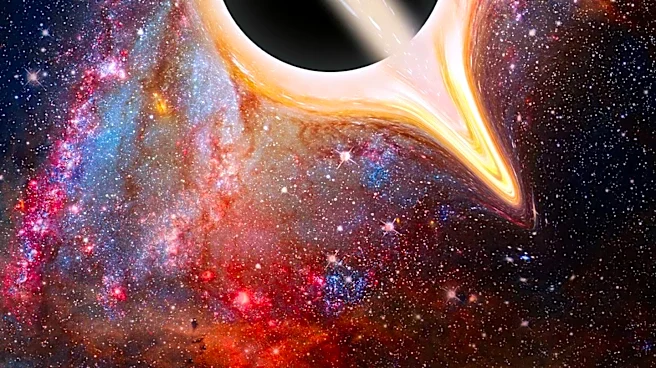
after half a century of scientific inquiry, is no. The team conducted an in-depth mathematical analysis of Einstein’s vacuum equations, which describe spacetime geometry in regions devoid of matter. Their findings prove the 'uniqueness conjecture,' demonstrating that no stable, time-independent configuration of multiple black holes aligned along the same axis of rotation can exist. Professor Weinstein explained that when more than one black hole is present in such a system, the gravitational forces between them cannot cancel each other out, resulting in a net attractive force along their common axis of rotation. This imbalance inevitably leads to dynamic evolution, such as mutual collapse and merger, rather than a static state.
Why It's Important?
This discovery represents a significant milestone in understanding the fundamental laws of the universe and general relativity. For decades, physicists, including Stephen Hawking, had explored the concept of black hole equilibrium, particularly concerning the 'no-hair theorems' which describe stable black holes by a limited set of properties like mass and angular momentum. While these theorems worked well for single black holes, the behavior of multiple black holes in close proximity remained an open question. The conclusive proof that static equilibrium is impossible for multiple black holes closes a critical gap in the study of general relativity. It deepens scientific understanding of the complex dynamics governing some of the most powerful objects in space, providing a clearer picture of how black holes interact and evolve, ultimately leading to mergers.
What's Next?
The resolution of this theoretical problem will likely influence future research in astrophysics and gravitational wave astronomy. With the understanding that multiple black holes cannot maintain a static equilibrium, scientists can refine models predicting black hole mergers and the gravitational waves they produce. This could lead to more accurate interpretations of data from gravitational wave observatories like LIGO. The discovery also encourages further exploration into the dynamic processes that govern black hole interactions, such as the precise mechanisms of their orbital decay and eventual collision. Researchers may now focus on developing more sophisticated simulations and observational techniques to capture these dynamic evolutions, further enhancing our comprehension of the universe's most extreme phenomena.
Beyond the Headlines
Beyond its immediate scientific implications, this breakthrough highlights the power of mathematical physics in unraveling the universe's deepest secrets. The problem, which remained unsolved for 50 years, underscores the complexity of Einstein's theory of general relativity and the challenges in applying it to multi-body systems. The definitive 'no' to static black hole equilibrium reinforces the dynamic and ever-changing nature of the cosmos, where even the most stable-seeming objects are subject to relentless gravitational forces. This understanding contributes to a broader philosophical perspective on the universe, emphasizing constant motion and transformation rather than static states. It also serves as a testament to the collaborative nature of international scientific research in tackling fundamental questions that push the boundaries of human knowledge.