
What's Happening?
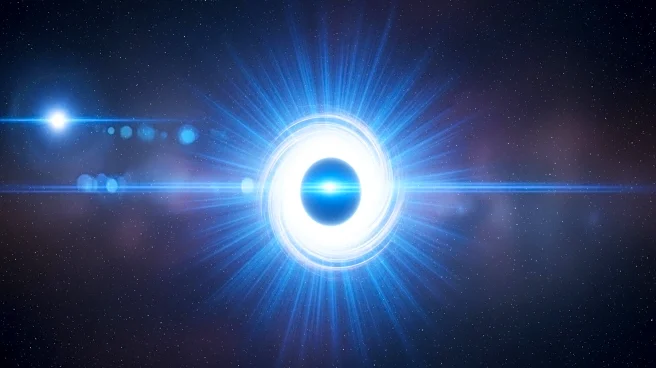
New research has identified black holes as the source of rare, short-lived blue light events known as luminous fast blue optical transients (LFBOTs). The study focused on a signal called AT 2024wpp, detected
in 2024, which is the brightest example of its kind. This event, occurring 1.1 billion light-years from Earth, released significantly more energy than typical supernovae and faded quickly. Researchers concluded that AT 2024wpp resulted from a tidal disruption event, where a black hole tore apart a nearby star. The findings suggest that LFBOTs occur under specific conditions involving smaller black holes and massive companion stars.
Why It's Important?
The identification of black holes as the cause of LFBOTs resolves longstanding uncertainties about these events. This discovery challenges previous models that attributed such phenomena to standard stellar explosions. By understanding the conditions that lead to LFBOTs, scientists can refine their models of stellar and black hole interactions. This research enhances our knowledge of cosmic events and the extreme environments in which they occur, potentially influencing future astronomical observations and theories about the life cycles of stars and black holes.
What's Next?
Future studies will likely focus on identifying more LFBOTs and understanding the specific conditions that lead to their formation. Researchers may use advanced telescopes and observatories to gather more data on these events, aiming to refine models of black hole and star interactions. This ongoing research could provide further insights into the dynamics of black holes and their impact on surrounding cosmic structures, contributing to a deeper understanding of the universe.