
What's Happening?
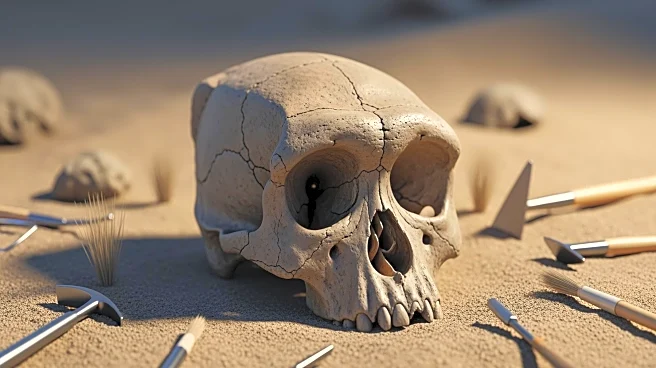
Archaeologists have uncovered a 1,400-year-old skull with a distinctive flat top in the Balcón de Montezuma Archaeological Zone, located in the Northern Huasteca region of Tamaulipas, Mexico. The skull,
belonging to a man who lived between 400 and 900 A.D., exhibits a rare form of cranial deformation known as the tabular erect type, characterized by a cube-like shape. This discovery, announced by Mexico's National Institute of Anthropology and History (INAH), marks the first identification of intentional cranial deformation at this site, revealing a variant not previously reported in this region of Mesoamerica. Researchers suggest that the skull's unique shape may have been significant in terms of identity and status, possibly indicating a shaman-like role within the community.
Why It's Important?
The discovery of this skull provides new insights into the cultural practices and social structures of ancient Mesoamerican societies. The intentional cranial deformation suggests a complex understanding of identity and status, highlighting the diversity of cultural expressions in the region. This find contributes to the broader understanding of intercultural relationships in the Huasteca region, particularly in relation to the North and the Sierra Madre Oriental of Mexico. It underscores the ethnic diversity and physical characteristics of the inhabitants, offering valuable data for anthropologists and historians studying the region's past.
What's Next?
Further analysis of the skull and associated artifacts, such as the small circular shell beads found in the grave, will likely continue to shed light on the cultural and social dynamics of the time. Researchers may explore the connections between this site and other regions, potentially uncovering more about the trade, communication, and cultural exchanges that occurred in ancient Mesoamerica. Continued archaeological efforts in the area could lead to additional discoveries that further illuminate the history and development of these early societies.
Beyond the Headlines
This discovery raises intriguing questions about the role of physical appearance in ancient societies and how it may have been used to signify social roles or spiritual beliefs. The practice of cranial deformation, while not uncommon in Mesoamerica, varies significantly across regions, suggesting localized cultural practices and beliefs. Understanding these differences can provide deeper insights into the cultural identity and social hierarchies of ancient civilizations, as well as their interactions with neighboring groups.