
What's Happening?
Andrew Newhouse, an environmental biologist and director of the American Chestnut Research and Restoration Project at the State University of New York, has discussed a recent milestone in the effort to genetically
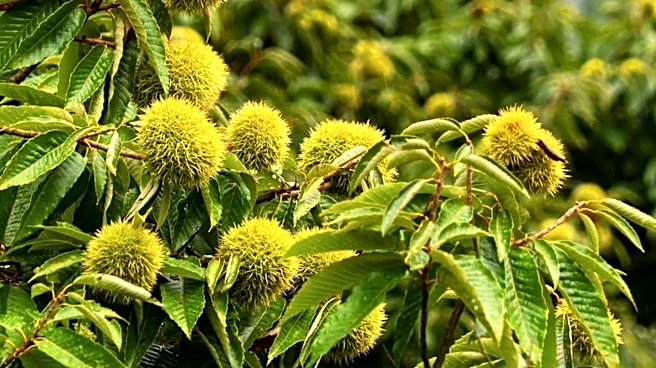
revive the American chestnut tree. The project received its first of several necessary approvals from U.S. federal regulatory agencies, which will allow for the distribution and use of genetically engineered disease-resistant chestnut trees for restoration. The American chestnut, once a dominant species in Eastern U.S. forests, was nearly wiped out by a deadly blight. The project utilizes biotechnology, specifically genetic engineering, to introduce a single gene from wheat into the chestnut trees. This gene helps the trees tolerate the blight by reducing the damage it causes, rather than preventing the disease entirely. This approach is considered unique and offers significant hope for the restoration of this important native tree species.
Why It's Important?
The potential restoration of the American chestnut tree holds significant ecological and economic importance for the U.S. The American chestnut was a crucial component of the Eastern woodland ecosystem, providing a vital food source for both people and wildlife. Its near extinction left a void in these forests. The success of this genetic engineering project could reintroduce a keystone species, contributing to biodiversity and ecosystem health. Furthermore, this project serves as a precedent for using biotechnology in conservation efforts, potentially offering solutions for other native trees threatened by diseases. The ability to restore such a prominent species could also have economic benefits related to forestry, wildlife management, and potentially even a niche market for chestnuts. The project also addresses the broader challenge of preserving native species against invasive diseases, which is a growing concern for U.S. natural resources.
What's Next?
Following the initial regulatory approval, the American Chestnut Research and Restoration Project anticipates receiving further approvals from U.S. federal agencies. Andrew Newhouse expects that the distribution of these genetically engineered trees could begin within a few years. However, he emphasizes that the restoration process will be gradual, taking decades to achieve landscape-scale changes across the American chestnut's original range. The project aims to involve the public in planting efforts, allowing individuals to contribute to the restoration and witness initial progress relatively soon. The long-term goal is to see chestnut trees return to the wild, filling their historical ecological role and providing an example for protecting other threatened native tree species through similar biotechnological approaches.
Beyond the Headlines
The genetic engineering of the American chestnut tree raises deeper implications regarding the use of genetically modified organisms (GMOs) in environmental conservation. While critics often express concerns about the long-term effects of GMOs, Newhouse highlights the extensive research conducted by his team and other labs, as well as the detailed review by regulatory agencies, suggesting these trees are among the most studied. This project could shift public perception and policy regarding the application of biotechnology for ecological restoration, especially when traditional breeding methods are more complex or less effective. It also prompts discussions about the balance between preserving natural ecosystems and intervening with advanced scientific methods to combat environmental threats. The success of this initiative could pave the way for broader acceptance and implementation of genetic engineering as a tool for addressing biodiversity loss and ecosystem degradation in the U.S. and globally.