
What's Happening?
A distant object emitting X-rays, detected by NASA's Chandra X-ray Observatory and the James Webb Space Telescope, may provide insights into the enigmatic 'little red dots' (LRDs) observed in the early
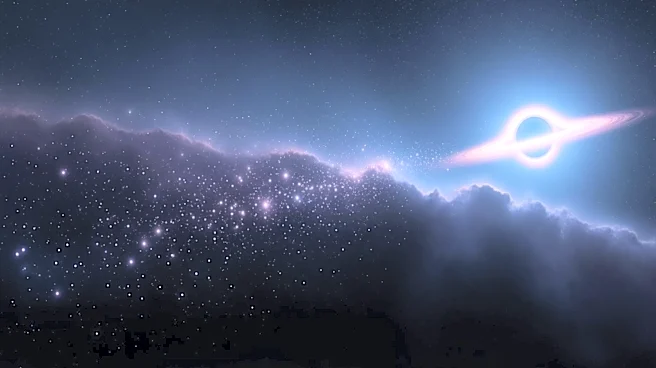
universe. These compact, reddish objects, located over 12 billion light-years away, have puzzled astronomers due to their unusual properties. The object, 3DHST-AEGIS-12014, stands out by emitting detectable X-rays, suggesting it could be a transitional phase of a supermassive black hole consuming its surroundings. This discovery could reshape current models of galaxy evolution and black hole growth.
Why It's Important?
Understanding these LRDs is crucial as they may trace the rapid assembly of black holes in the young universe. If confirmed, this could significantly impact our knowledge of cosmic history and the formation of massive celestial bodies. The findings could lead to a deeper understanding of how supermassive black holes grow and influence their environments. This research highlights the importance of advanced telescopes and international collaboration in uncovering the universe's mysteries.
What's Next?
Future observations are expected to clarify whether the object is indeed a transitional phase of a black hole or a conventional growing black hole obscured by unusual dust. Continued analysis of data from Webb and Chandra will be essential in confirming these hypotheses. The scientific community anticipates that further studies will provide more definitive answers, potentially leading to new insights into the early universe's structure and the role of black holes in cosmic evolution.