


What's Happening?
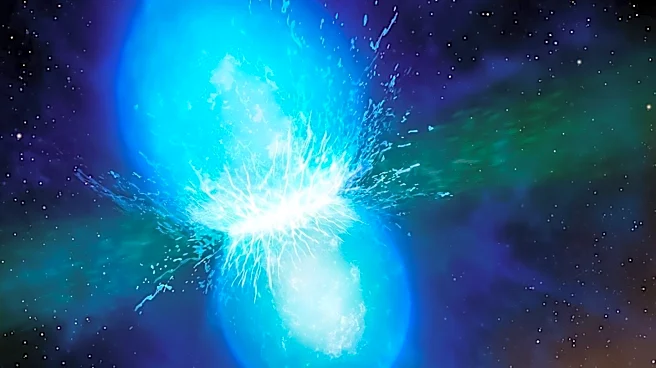
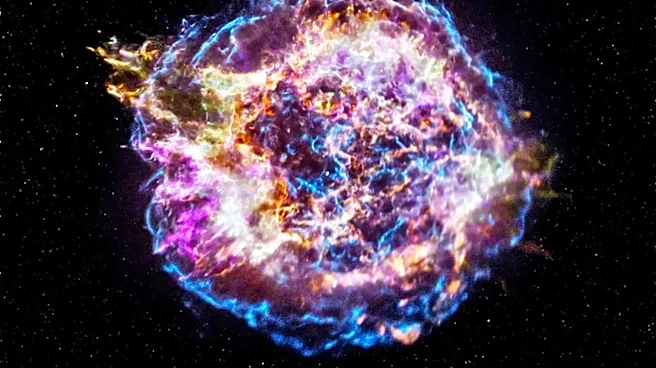
Visible-light observations of the Ibn-type supernova SN 2023uqf have revealed conditions under which cosmic rays could be accelerated to PeV energies. A research team, including scientists from RIKEN, used a radiation-hydrodynamics model to analyze the supernova's
shock radius, velocity, and surrounding gas density. The model predicts that the 442 TeV neutrino event IC-231004A, detected by IceCube, falls within the timing and energy range. However, the expected detection count is low, suggesting that while SN 2023uqf is not ruled out as a source, it remains a candidate rather than a confirmed origin.
Why It's Important?
The study provides insights into the conditions necessary for supernovae to act as pevatrons, capable of accelerating particles to extremely high energies. Understanding these conditions could advance the identification of cosmic ray sources and improve models of particle acceleration in astrophysical phenomena. The research highlights the importance of combining observational data with theoretical models to explore high-energy astrophysical events.
What's Next?
Further research is needed to refine the model and incorporate loss-inclusive calculations, which could lower the upper limit on high-energy side predictions. Observations of nearby supernovae with similar properties could help confirm SN 2023uqf as a pevatron source. Continued collaboration between observational and theoretical astrophysics will be crucial in advancing the understanding of cosmic ray acceleration.