




What's Happening?
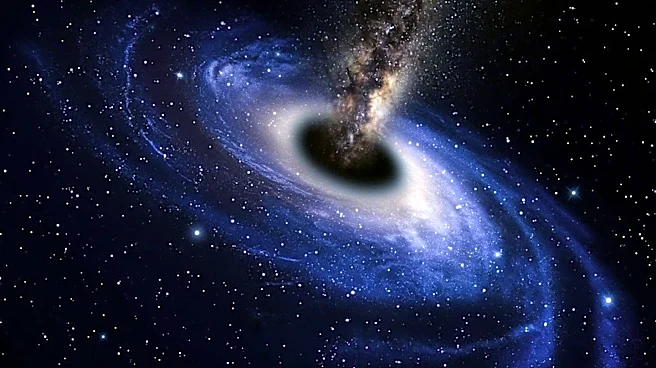
An international team of astronomers has identified eight supermassive black holes that are significantly more massive relative to their host galaxies than typically observed. These black holes, with masses ranging from 800 million to four billion solar
masses, account for at least five percent of their host galaxies' stellar mass, a ratio of 1:20. This is more than ten times the usual ratio of 1:200 found in the nearby universe. The discovery, led by the Max Planck Institute for Extraterrestrial Physics (MPE), utilized data primarily from the eROSITA X-ray telescope, supplemented by observations across ultraviolet, optical, and infrared wavelengths, including the Sloan Digital Sky Survey. The black holes are actively accreting matter, indicating they are still growing and could double their mass within approximately one billion years. This finding challenges the long-held assumption that black holes and their host galaxies grow in a closely coupled, synchronized manner.
Why It's Important?
This discovery is important because it fundamentally challenges existing theoretical models of galaxy and black hole co-evolution. Current cosmological simulations, including Illustris, TNG, Horizon-AGN, EAGLE, Simba, Magneticum, and ASTRID, consistently predict a black hole to stellar mass ratio close to the typical 1:200, failing to produce systems as extreme as those observed. This systematic discrepancy suggests a significant gap in our understanding of how black holes accumulate mass and interact with their galactic environments. The existence of these 'overmassive' black holes at redshifts of 0.3 to 0.8 (three to seven billion years after the Big Bang) indicates that this phenomenon is not limited to the very early universe, as suggested by some James Webb Space Telescope findings, but may represent an ongoing growth channel across a substantial portion of cosmic history. Understanding this process could lead to a revised understanding of galaxy formation and evolution.
What's Next?
Future research will focus on determining how common these overmassive systems are and the physical processes driving their formation. Additional data from the eROSITA telescope, along with high-resolution observations from upcoming facilities and spectroscopic surveys like 4MOST, will be crucial. Researchers will investigate three main scenarios: whether the black holes' energetic outflows quenched star formation in their host galaxies early on, leaving the galaxies stunted; if these black holes originated from unusually massive 'seed' objects in the early universe; or if they sustained prolonged periods of accretion above the Eddington limit, growing faster than standard physics predicts. Higher-resolution imaging will be needed to determine the morphology and stellar populations of the faint host galaxies and to distinguish between these hypotheses. The ongoing analysis of existing eROSITA data and future observations will help refine cosmological simulations and provide a more complete picture of black hole and galaxy co-evolution.
Beyond the Headlines
The existence of black holes that have grown disproportionately large relative to their host galaxies introduces a profound puzzle in astrophysics, potentially reshaping our understanding of cosmic evolution. This phenomenon suggests that the relationship between a supermassive black hole and its galaxy might be more complex and less synchronized than previously thought, implying that black holes can sometimes evolve independently of their stellar populations. The 'Great Dane in a studio apartment' analogy highlights the extreme nature of these systems, pushing the boundaries of current theoretical frameworks. This challenge to established models could lead to new physics or a re-evaluation of fundamental assumptions about gravity, matter accretion, and energy feedback in the universe. It also provides a potential link to the 'overmassive' black holes observed in the early universe, suggesting a continuous, albeit poorly understood, growth channel that has operated throughout cosmic history, impacting the development of galaxies across billions of years.