



What's Happening?
A new analysis warns that nearly half of the world's wild fish catch, up to 34.6 million tonnes annually, could be ground into feed for farmed salmon and shrimp by 2040 if current industry trends continue. This projection challenges the United Nations
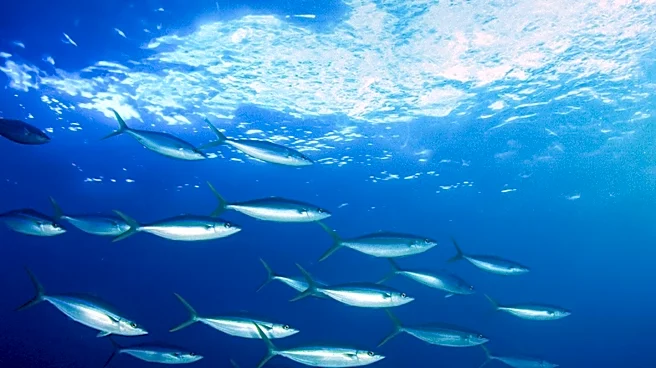
Food and Agriculture Organization's (FAO) 'blue transformation' agenda, which aims to increase aquaculture output by 75% by 2040 to enhance food security and combat hunger. Campaign groups, including the Changing Markets Foundation, whose modeling with the University of British Columbia underpins the analysis, argue that the FAO's plan could deplete marine ecosystems and negatively impact coastal communities reliant on wild fish. Farmed fish already constitute over half of the aquatic animals consumed globally, with carnivorous species like salmon and shrimp requiring fishmeal and fish oil derived from smaller wild fish such as anchovies and sardines for their feed.
Why It's Important?
This analysis has significant implications for global food systems, marine ecosystems, and the U.S. seafood market. The potential diversion of nearly half of the wild fish catch to aquaculture feed could exacerbate pressures on already strained marine resources, impacting biodiversity and the ecological balance of oceans. For the U.S., which is a major consumer of farmed seafood, this trend could lead to increased reliance on imported fishmeal and fish oil, potentially driving up costs for domestic aquaculture operations and feed manufacturers. It also raises questions about the sustainability of current aquaculture practices and the long-term availability of wild fish for direct human consumption. Coastal communities in the U.S. and globally, whose livelihoods depend on wild fisheries, could face economic hardship due to reduced fish stocks. The debate also highlights a fundamental tension between increasing food production to meet global demand and preserving natural resources for future generations.
What's Next?
The debate now centers on whether the FAO will attach conditions to its 75% aquaculture growth target. Campaign groups like the Changing Markets Foundation are advocating for limits on the volume of wild fish used in feed production and a shift towards farmed species that do not require wild-caught inputs. The FAO, while defending its expansion plan as crucial for food security, particularly in regions like Africa, may face increasing pressure to incorporate more sustainable practices. This could include promoting extensive fish farming models that do not rely on external feed, as suggested by analysts at the Breakthrough Institute. For the U.S. and other major seafood markets, consumers and policymakers may demand greater transparency regarding the sourcing of farmed fish feed and push for certifications that ensure sustainable practices. Research into alternative feed ingredients that reduce reliance on wild fish will likely intensify, potentially leading to new innovations in aquaculture feed technology.
Beyond the Headlines
The controversy surrounding the FAO's aquaculture expansion plan delves into deeper ethical and environmental considerations. The practice of grinding wild fish to feed farmed fish, particularly carnivorous species, raises questions about the efficiency and morality of food production systems. It highlights a potential paradox where efforts to increase food security through aquaculture could inadvertently undermine the very ecosystems that provide food. This issue also touches upon food justice, as the diversion of small pelagic fish, often a staple for vulnerable coastal communities, to feed high-value farmed species for wealthier markets, could worsen food insecurity in those regions. The long-term implications include not only ecological degradation but also socio-economic disparities. Addressing this challenge requires a holistic approach that integrates ecological sustainability, social equity, and economic viability, pushing for a fundamental re-evaluation of how global food demand is met without compromising the health of the planet or the well-being of its most vulnerable populations.