


What's Happening?
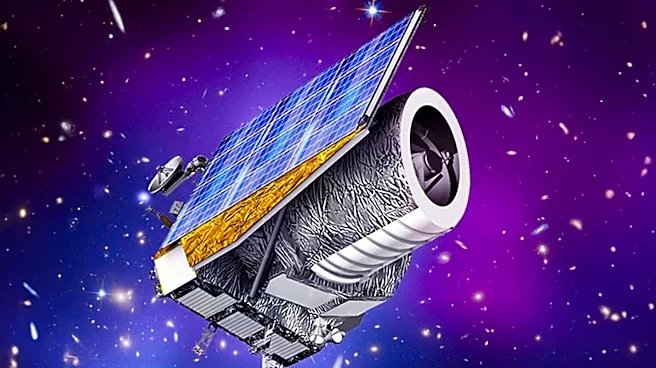
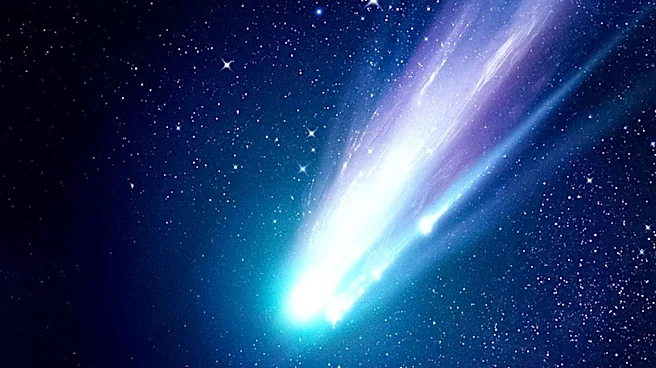
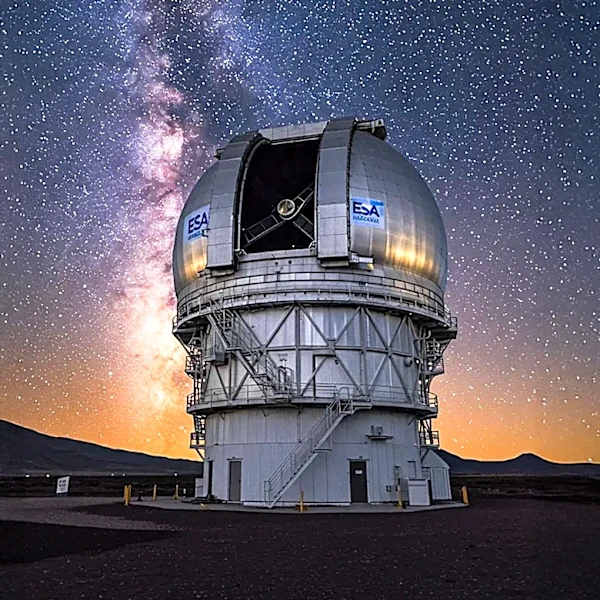
The European Space Agency's Euclid space telescope, primarily designed to study dark energy and dark matter in deep space, has unexpectedly discovered its first comet, designated C/2026 S1, or comet Euclid. The discovery was made during observations between
September 16 and 24, when the telescope spotted the previously undetected comet approximately 807 million miles (1.3 billion kilometers) away, whirling between the orbits of Jupiter and Saturn. Mikko Pöntinen, a scientist at the University of Helsinki, identified a 'streak' in several images, which further inspection revealed to be an active object with a fuzzy cloud, indicative of a comet shedding dust and gas. This finding is significant because Euclid was not explicitly designed to capture fast-moving objects within our solar system, but rather to conduct long, slow observations of distant galaxies.
Why It's Important?
This unexpected discovery demonstrates Euclid's versatility and potential for broader astronomical applications beyond its primary mission. While its main goal is to unravel the mysteries of dark energy and dark matter, the ability to detect comets in the outer solar system opens new avenues for research. Such observations can help scientists intentionally target other comets in the far reaches of our solar neighborhood in the future, providing valuable data on their composition and behavior. Additionally, identifying comets and their trails is crucial for distinguishing them from 'noise' in Euclid's deep-space observations, ensuring the accuracy of data related to distant galaxies. This unexpected capability enhances the scientific return of the Euclid mission and expands the tools available for solar system exploration.
What's Next?
The discovery of comet C/2026 S1 suggests that Euclid could be utilized for future targeted observations of comets in the outer solar system. This expanded utility could lead to a better understanding of these icy bodies, which are remnants from the early solar system and can provide clues about its formation and evolution. Researchers will likely continue to analyze Euclid's data for other unexpected findings, potentially uncovering more objects within our solar system that were not the primary focus of the mission. The ability to identify and account for such 'noise' will also refine the telescope's primary mission of mapping the universe and studying dark matter and dark energy, ensuring cleaner and more accurate data for cosmological studies.
Beyond the Headlines
The serendipitous discovery of comet C/2026 S1 highlights the unpredictable nature of scientific exploration and the potential for instruments to yield unexpected insights. It underscores the value of broad observational capabilities in space missions, as instruments designed for one purpose can often contribute to other fields of study. This event could inspire future mission designs to incorporate more versatile observational modes, maximizing scientific output. Furthermore, the discovery reinforces the idea that our solar system, even in its outer reaches, still holds many secrets waiting to be uncovered, challenging our current understanding and pushing the boundaries of astronomical knowledge.