
What's Happening?
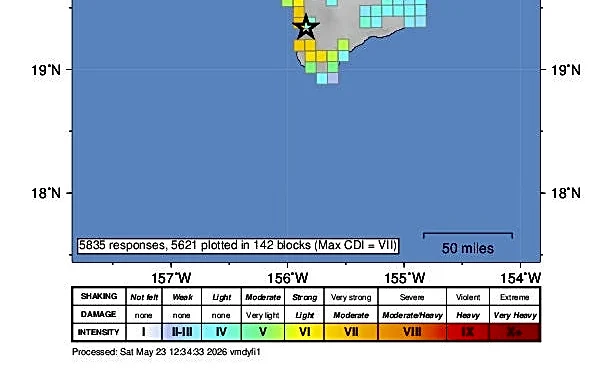
A magnitude-6.0 earthquake struck the west flank of Mauna Loa volcano on the Big Island of Hawaii on May 22, 2026, causing strong to very strong shaking. The earthquake, which occurred at 9:46 p.m., resulted
in light to moderate damage, including items falling from shelves and small cracks in walls. Power outages were reported, and large rocks and debris fell onto roadways, prompting police to advise the public to avoid certain areas. The U.S. Geological Survey recorded over 2,660 'Felt Reports' within the first hour, with the epicenter located 7.5 miles south of Hōnaunau-Nāpō’opo’o at a depth of over 15 miles. The Hawaiian Volcano Observatory stated that the earthquake was caused by stress due to the bending of the oceanic plate and was not directly related to volcanic activity. No tsunami threat was reported.
Why It's Important?
The earthquake highlights the ongoing geological activity in Hawaii, which can have significant implications for infrastructure and public safety. The damage and power outages underscore the need for preparedness in earthquake-prone regions. The event also serves as a reminder of the potential for aftershocks, which could further impact the area. The response from local authorities, including road closures and damage assessments, is crucial in mitigating the effects of such natural disasters. Understanding the causes and effects of earthquakes in Hawaii is essential for developing strategies to protect residents and infrastructure.
What's Next?
Authorities are conducting damage assessments around the Big Island, and residents are advised to check for damages to their homes, particularly utility connections. The Hawaiian Volcano Observatory and Civil Defense warn of possible aftershocks, although they are unlikely to be large enough to cause significant damage. The situation will continue to be monitored, and updates will be provided as necessary. Residents and visitors are encouraged to report any damage to the Hawaii County Civil Defense.