






What's Happening?
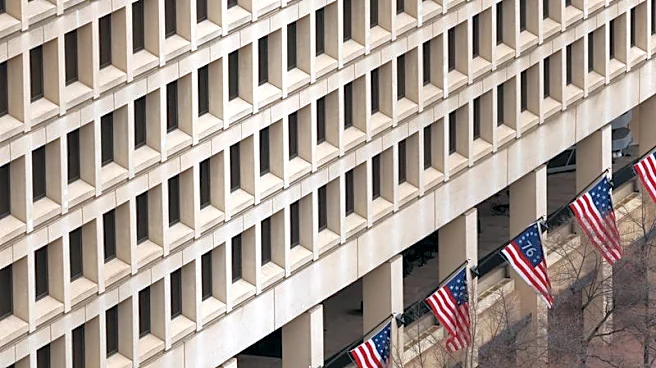
A federal judge in Greenbelt, Maryland, has ruled against the Trump administration's attempt to move the FBI's new headquarters from Greenbelt to the Ronald Reagan Building in Washington, D.C. U.S. District Judge Theodore D. Chuang issued a permanent
injunction, blocking the administration from spending any funds to facilitate this move. The ruling stems from a lawsuit filed by Maryland and Prince George's County, which argued that the Trump administration illegally redirected over $1 billion in congressionally approved funding. The court found that the FBI and General Services Administration (GSA) lacked the statutory authority to select a site not approved by Congress. Congress had previously mandated that the GSA choose from three specific locations: Greenbelt, Landover, or Springfield, Virginia, with Greenbelt being selected in September 2023. The judge vacated and declared void the FBI's site selection, GSA's site selection, and the associated funding reprogramming, deeming them 'arbitrary and capricious' and based on a 'misapprehension of existing law.'
Why It's Important?
This ruling is significant as it reaffirms the principle of checks and balances, asserting that the executive branch cannot unilaterally override congressional mandates regarding federal projects. Maryland officials, including Attorney General Anthony Brown and Governor Wes Moore, have hailed the decision as a victory for the rule of law and for the state. The relocation of the FBI headquarters to Greenbelt is projected to be the largest economic development project in Prince George's County's history, estimated to create over 7,500 jobs and add approximately $4 billion to the GDP of the county and state. The court's decision ensures that these economic benefits, which were jeopardized by the attempted relocation, remain within reach for Maryland. It also underscores the importance of adhering to established legal processes and congressional appropriations, preventing executive actions from undermining long-term planning and investment in communities.
What's Next?
Following the court's injunction, the administration is permanently blocked from taking further steps to advance the Reagan Building relocation, including spending or disbursing funds for it. The court has ordered the parties to file a joint status report within 14 days to address next steps and determine if the case can be closed. While the ruling does not explicitly order the FBI to immediately begin construction in Greenbelt, it removes the legal obstacle posed by the attempted move to the Reagan Building. The Justice Department has not yet indicated whether it will appeal the decision to the Fourth Circuit. Maryland officials, including Governor Wes Moore, have urged for an end to 'political games' and a focus on building the new FBI headquarters in Greenbelt, emphasizing the need to fulfill the promise to FBI public servants.
Beyond the Headlines
The legal battle over the FBI headquarters location highlights a broader tension between executive authority and congressional oversight, particularly concerning large-scale federal projects and the allocation of taxpayer funds. The court's emphasis on the 'clear and unequivocal language' required for congressional ratification of executive actions sets a precedent for future disputes over statutory interpretation. This case also brings to light the long-term planning and significant investments made by states and localities in anticipation of federal projects, and the potential for political shifts to disrupt these plans. The ruling reinforces the idea that once Congress makes a decision and funds are appropriated for a specific purpose, the federal government cannot simply disregard it. The 15-year history of the project, including the initial concerns about the J. Edgar Hoover Building's security and the abrupt cancellation in 2017, underscores the complex and often politicized nature of major federal infrastructure initiatives.