


What's Happening?
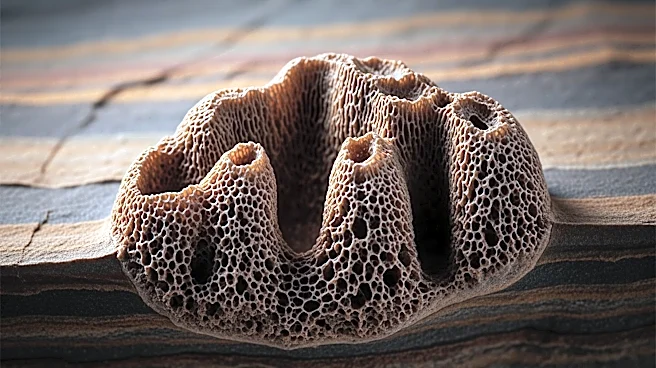
Scientists have discovered a 550-million-year-old sponge fossil along the Yangtze River in China, which helps bridge a 160-million-year gap in the history of early life on Earth. The fossil, described by geobiologist Shuhai Xiao and his team, challenges
previous assumptions about the origins of sponges and the appearance of early animal life. The fossil's surface features suggest it is closely related to glass sponges, and its size and complexity defy expectations for early sponges. The discovery provides insight into the evolution of sponges and the conditions necessary for their preservation.
Why It's Important?
The discovery of this ancient sponge fossil has significant implications for understanding the evolution of early life on Earth. It suggests that the first sponges may have been entirely soft-bodied, lacking mineral skeletons, which explains the absence of conventional fossil traces. This realization shifts the focus of researchers to seek out rare geological environments where delicate organisms could be preserved. The findings challenge existing theories about the appearance and preservation of early sponges, prompting a reevaluation of how scientists search for early life.
What's Next?
Researchers will continue to explore unusual geological environments to uncover more fossils that can provide insights into early animal life. The discovery encourages scientists to broaden their search criteria and consider the possibility of soft-bodied organisms leaving traces under exceptional conditions. Further studies may reveal more about the evolutionary history of sponges and other early life forms, contributing to a deeper understanding of Earth's biological past.
Beyond the Headlines
The discovery highlights the importance of interdisciplinary collaboration in paleontology, combining expertise in geology, biology, and paleontology to uncover new insights into early life. It underscores the need for innovative approaches to fossil research, considering the potential for soft-bodied organisms to be preserved under specific conditions. The findings may lead to a reevaluation of the fossil record and the methods used to study ancient life.