





What's Happening?
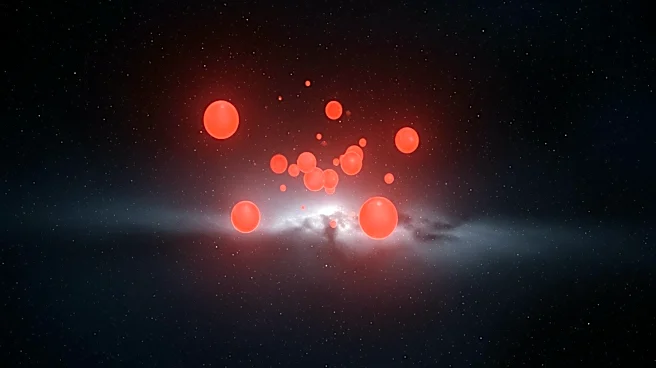
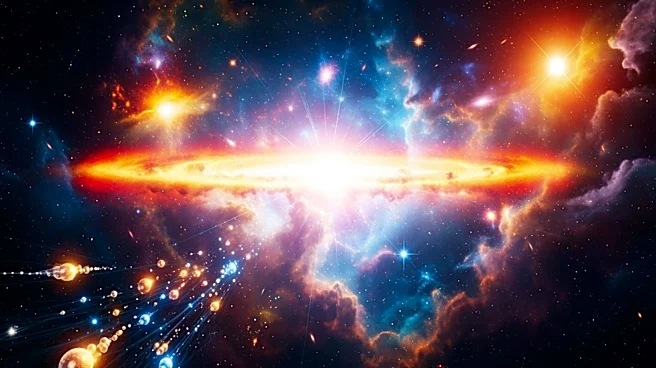
In 1987, a supernova in the Large Magellanic Cloud, known as SN 1987A, provided the first direct evidence of a core-collapse supernova through the detection of neutrinos. Detectors in Japan, the United States, and the Soviet Union recorded a burst of neutrinos hours
before the light from the supernova was visible on Earth. This event confirmed theoretical predictions about the role of neutrinos in supernovae and provided insights into the processes occurring during a star's collapse. The detection of neutrinos from SN 1987A marked a significant milestone in neutrino astronomy.
Why It's Important?
The detection of neutrinos from SN 1987A validated decades of theoretical work on core-collapse supernovae, transforming them from theoretical constructs into observed phenomena. This event demonstrated the potential of neutrino astronomy to provide unique insights into the universe's most energetic events. The ability to detect neutrinos from such distances also set the stage for future discoveries, as modern detectors are now capable of capturing thousands of neutrinos from similar events, offering a deeper understanding of stellar evolution and the life cycle of stars.
What's Next?
The remnant of SN 1987A continues to be a subject of study, with ongoing observations planned using the James Webb Space Telescope and ground-based telescopes. As the debris from the supernova clears, astronomers hope to gain a clearer view of the suspected neutron star at its center. The next nearby supernova could provide an opportunity to capture a much larger number of neutrinos, further advancing our understanding of these cosmic events and the fundamental properties of neutrinos.