










What's Happening?
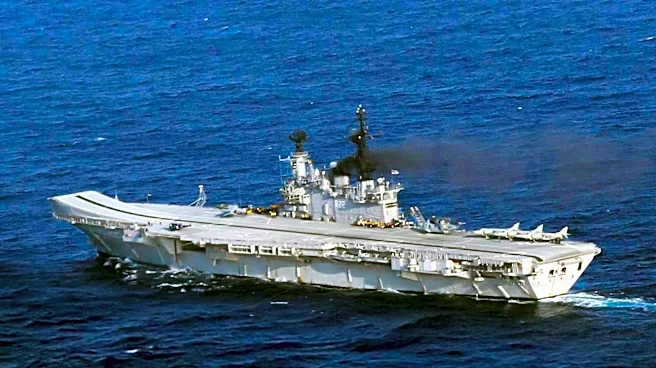
Recent footage of China's first Type 076 amphibious assault ship, named Sichuan, has revealed significant advancements in its design, indicating its capability to operate fixed-wing unmanned aerial vehicles (UAVs). The footage, initially released by China National
Radio, shows the ship's topside nearing completion, with features such as an electromagnetic catapult and arresting gear, suggesting a focus on UAV operations. This development marks a significant step in China's naval capabilities, as the Type 076 is expected to be the first amphibious assault ship equipped with both an electromagnetic catapult and an arrested-recovery system. The ship, with an estimated displacement of 40,000 to 50,000 tonnes, bridges the gap between traditional amphibious assault platforms and light aircraft carriers. It is also designed to accommodate embarked marines, enhancing its operational versatility.
Why It's Important?
The introduction of the Type 076 ship with UAV capabilities represents a strategic enhancement of China's naval power, potentially altering the balance of military capabilities in the Asia-Pacific region. This development could heighten tensions with neighboring countries, particularly Taiwan, which is already under pressure from increased Chinese military activities. The ability to deploy UAVs from such a platform extends China's reach and surveillance capabilities, posing a challenge to U.S. and allied forces in the region. The ship's advanced features may also prompt other nations to accelerate their own military advancements, potentially leading to an arms race in the region. This move underscores China's commitment to expanding its influence and asserting its territorial claims, particularly in contested areas like the South China Sea.
What's Next?
As the Type 076 ship nears completion, its deployment will likely be closely monitored by regional and global powers. The U.S. and its allies may respond by increasing their military presence and conducting more frequent joint exercises in the region to counterbalance China's growing capabilities. Diplomatic efforts may also intensify to address the potential security implications of this development. Additionally, other countries in the region may seek to enhance their own military capabilities, either through domestic development or by strengthening alliances with major powers like the U.S. The completion and operational deployment of the Type 076 will be a key indicator of China's future military strategy and its impact on regional security dynamics.