




What's Happening?
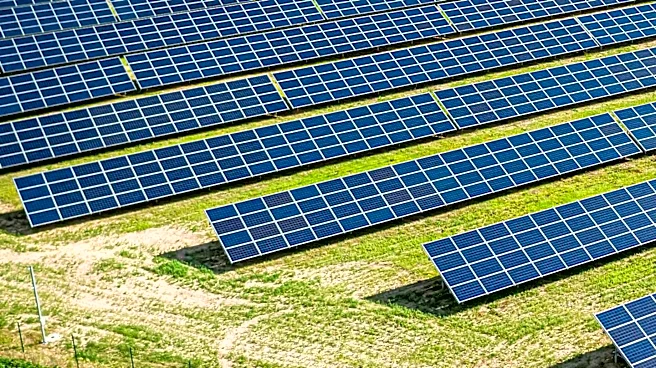
A five-year study conducted at two large solar farms in southern Minnesota, operated by Enel Green Power North America, has demonstrated a significant increase in insect abundance and native bee populations. These solar sites, built on retired farmland,
were intentionally planted with native grasses and flowering plants beneath and around the solar panels, rather than being left bare or mowed. Researchers from Argonne National Laboratory and the National Renewable Energy Laboratory conducted 358 surveys between August 2018 and August 2022. The findings indicate that over this period, the total number of insects roughly tripled, and native bee populations increased approximately twentyfold. The study also observed an increase in the diversity of native plants and flowers as the habitat matured. Beyond the solar farm boundaries, the study found that the proximity to this restored habitat boosted bee visits to soybean flowers in adjacent crop fields, suggesting a positive spillover effect on agricultural pollination.
Why It's Important?
This study challenges the conventional view that solar farms and agricultural land are mutually exclusive, offering a 'solar-versus-farmland' framing. With the Department of Energy’s Solar Futures Study estimating that up to 10 million acres could be needed for large-scale solar in the U.S. by 2050, and approximately 80% of future ground-mounted solar potentially located on farmland, the question of land use is critical. The Minnesota project demonstrates a viable model for integrating renewable energy production with ecological restoration and agricultural benefits. By fostering pollinator populations, these 'habitat-friendly' solar farms can enhance biodiversity and provide essential pollination services to nearby crops, which can lead to improved yields for farmers. This approach could mitigate concerns about land competition and offer a pathway for sustainable energy development that supports, rather than detracts from, local ecosystems and agricultural productivity.
What's Next?
The success of these Minnesota solar farms suggests a potential shift in how large-scale solar projects are developed and managed across the U.S. While the study is a strong proof of concept, further research is needed to determine how effectively this approach can be replicated in different regions with varying climates and ecosystems. The economic viability of such plantings is also a key factor; seeding native grasses and wildflowers and maintaining them over years is more costly than traditional methods like gravel or mowing. The widespread adoption of pollinator-friendly solar practices will depend on whether the financial benefits, such as enhanced crop pollination and ecosystem services, outweigh the additional upfront and maintenance costs, and if developers and policymakers are willing to invest in these long-term ecological advantages. Future policy incentives or regulations could encourage or mandate such practices, potentially making them a standard for new solar installations.
Beyond the Headlines
The deeper implications of this study extend to the broader conversation about sustainable land use and the integration of renewable energy infrastructure with environmental conservation. It highlights the potential for 'agrivoltaics' or 'pollinator-friendly solar' to transform how we perceive and utilize land for energy production. This model moves beyond simply minimizing environmental impact to actively creating ecological benefits. Ethically, it underscores a responsibility to design infrastructure that supports biodiversity and ecosystem health, rather than solely focusing on energy output. Culturally, it could foster a greater appreciation for the interconnectedness of energy, agriculture, and natural ecosystems. The long-term shift could see solar farms evolve into multi-functional landscapes that not only generate clean energy but also serve as vital habitats for pollinators, contributing to food security and ecological resilience in the face of climate change and habitat loss.