




What's Happening?
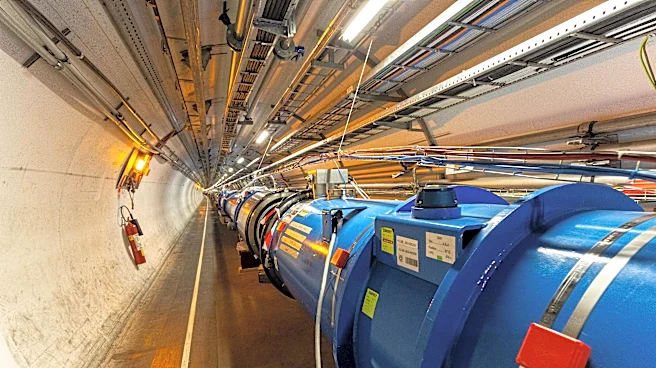
Scientists at CERN's Large Hadron Collider (LHC) have observed an extremely rare decay of matter, marking a significant step towards exploring the 'zeptoverse'—a scale of reality many times smaller than an atom. During proton collisions, researchers found
evidence that a neutral B meson decayed into a muon and an antimuon. This specific decay is predicted by the Standard Model of particle physics to occur only once for every 10 billion neutral B meson decays, making its observation a four-decade-long pursuit for physicists. The discovery was made possible by upgrades to the LHC in 2024, which enabled faster data collection, and new machine-learning techniques that helped filter out overwhelming background signals. The details of this phenomenon have been made available in a preprint on arXiv, and the results are currently consistent with existing physics predictions.
Why It's Important?
This breakthrough is crucial for testing the limits of the Standard Model of particle physics and potentially uncovering new physics beyond it. The Standard Model is the most comprehensive theory describing fundamental particles and forces, but it does not account for phenomena like dark matter, dark energy, or gravity at the quantum level. Observing such a rare decay with high precision allows physicists to scrutinize the model's predictions and search for subtle deviations that could indicate the presence of unknown particles or forces. Exploring the zeptoverse, where distances are measured in zeptometers (one quadrillionth of a meter), could provide insights into the earliest moments of the universe after the Big Bang, when matter was incredibly dense and hot. This research pushes the boundaries of human understanding of the fundamental constituents of reality.
What's Next?
While the current results are consistent with the Standard Model, future measurements with even greater precision and data collection will be critical. Scientists will continue to analyze more data from the upgraded LHC to refine their observations of this rare decay. Any future discrepancies between experimental results and theoretical predictions could signal new physics and open avenues for exploring phenomena unique to the zeptoverse. The ongoing development of advanced machine-learning techniques will further enhance the ability to detect and analyze these elusive events. The ultimate goal is to gain access to even smaller scales, such as the Planck length, which could provide a deeper understanding of quantum gravity and the universe's origins.
Beyond the Headlines
The exploration of the zeptoverse represents humanity's relentless pursuit of knowledge at the most fundamental levels of existence. This research has profound philosophical implications, challenging our perceptions of reality and the nature of matter. The technological advancements required for such experiments, including the development of powerful particle accelerators and sophisticated data analysis tools, often have spin-off benefits in other scientific and industrial fields. The international collaboration at CERN exemplifies how global scientific efforts can tackle the most complex questions, fostering a shared understanding of the universe. While the immediate practical applications may not be apparent, fundamental discoveries in physics have historically laid the groundwork for revolutionary technologies that shape our world.