

What's Happening?
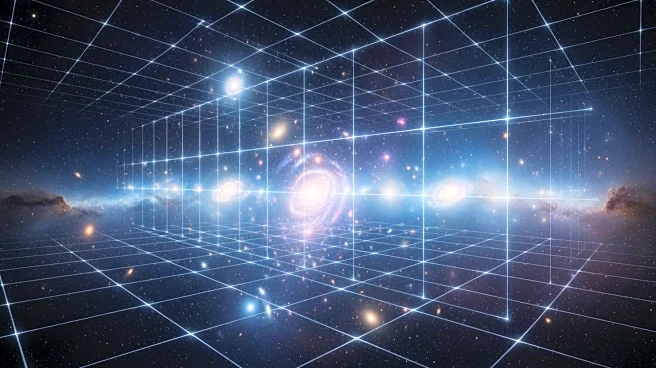
Astronomers working with the Hobby-Eberly Telescope Dark Energy Experiment (HETDEX) have created the most detailed three-dimensional map of the early universe, focusing on light produced by energized hydrogen, known as Lyman alpha light. This map, which
dates back approximately 9 to 11 billion years, helps locate bright galaxies during a period of intense star formation. The team used a method called Line Intensity Mapping to detect the combined glow of many distant objects, providing a more complete picture of the young universe. The findings, published in The Astrophysical Journal, highlight the potential of using this data for further research, as only a small fraction of the collected data is currently utilized.
Why It's Important?
This development is significant as it enhances our understanding of galaxy evolution and the role of intergalactic gas in this process. By mapping the early universe, scientists can better comprehend the formation and development of galaxies, which has implications for our understanding of dark energy and the universe's expansion. The research also opens new avenues for studying the universe's structure, potentially leading to breakthroughs in cosmology and astrophysics. The ability to map hidden galaxies could provide insights into the distribution of matter in the universe, influencing theories about dark matter and energy.
What's Next?
The researchers plan to compare their map with other surveys focusing on different elements, such as carbon monoxide, to gain a deeper understanding of the environments surrounding young stars. This comparison could lead to a more comprehensive understanding of the conditions that foster star formation. Additionally, the team aims to utilize the vast amount of untapped data for further research, potentially leading to new discoveries about the universe's early stages and the forces shaping it.