






What's Happening?
The flagship '35 by 35' initiative, spearheaded by Türkiye and Australia through the COP31 Presidency Action Agenda, aims to increase the share of electricity in global final energy consumption from approximately 20% today to 35% by 2035. Achieving this
goal necessitates an immediate and rapid transition to zero-emission vehicles (ZEVs), as electricity currently accounts for less than 1% of energy consumption in the road transport sector. While buildings and heavy industry dominate current electricity use, transport is the fastest-growing area for new demand. The International Council for Clean Transportation (ICCT) modeled two scenarios: a Baseline scenario based on current policies and market developments, and an Ambitious scenario reflecting full implementation of the ZEV Declaration and the Global Memorandum of Understanding (MOU) on Zero-emission Medium- and Heavy-Duty Vehicles.
Why It's Important?
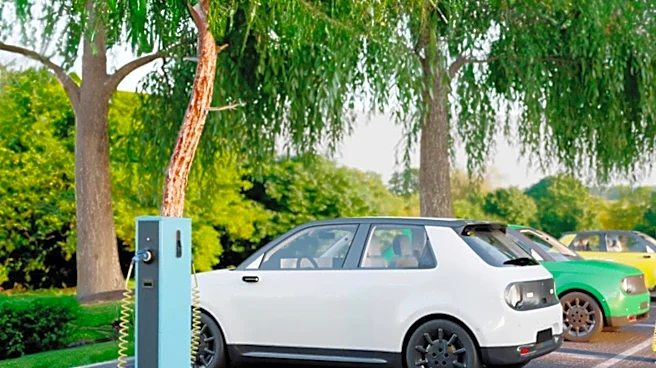
The '35 by 35' initiative is critical for global efforts to slash emissions, insulate economies from volatile oil and gas markets, and reduce hazardous air pollutants. Accelerating ZEV uptake, as outlined in the Ambitious scenario, could avoid an estimated 601 exajoules of cumulative liquid fossil fuel consumption in road transport through 2050, equivalent to the lifetime fuel consumption of 863 million gasoline-powered passenger cars. This transition offers a durable hedge against future fuel price shocks, as demonstrated by the estimated $5.8 billion in savings for the Indonesian government in 2025 due to electric cars displacing fossil fuel subsidies. Moreover, ZEVs can strengthen electricity grids through smart charging and bidirectional vehicle-to-grid (V2G) technology, allowing vehicles to draw power when renewables are cheapest and discharge energy back during peak demand, thereby smoothing grid stress and lowering system costs.
What's Next?
Governments preparing for COP31 are tasked with translating global ZEV commitments into enforceable domestic policies. The ZEV Declaration and Global MOU provide a multilateral governance framework to coordinate national targets, signaling to the market the need for private capital investment in manufacturing, battery supply chains, and charging infrastructure. Achieving the Ambitious scenario's trajectory will require a comprehensive, multi-tiered policy toolkit, including statutory ZEV mandates, stringent fleet-wide CO2 standards, and feebate systems in mature markets. For commercial freight, establishing dedicated charging corridors and fleet purchase requirements are crucial. Emerging economies are driving adoption through targeted fiscal policies and local manufacturing strategies, focusing on high-mileage urban fleets and two- and three-wheelers.
Beyond the Headlines
The transition to ZEVs and the '35 by 35' target represent a profound shift in global energy consumption patterns, with significant implications for infrastructure development and technological innovation. The integration of ZEVs into the grid through smart charging and V2G technology transforms them from mere consumers of electricity into active participants in grid management, offering flexibility and resilience. This paradigm shift could reduce the need for costly grid upgrades, as seen in California where managed charging and off-peak rates could slash projected distribution grid upgrade costs. The initiative also highlights the interconnectedness of climate policy, economic stability, and technological advancement, pushing for a future where transportation is not only cleaner but also a more integral and flexible component of the energy system.