




What's Happening?
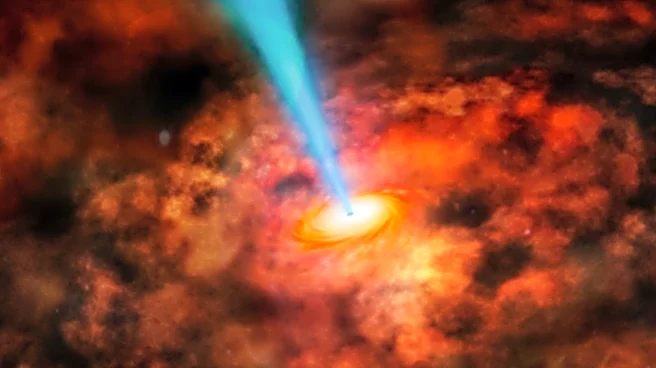
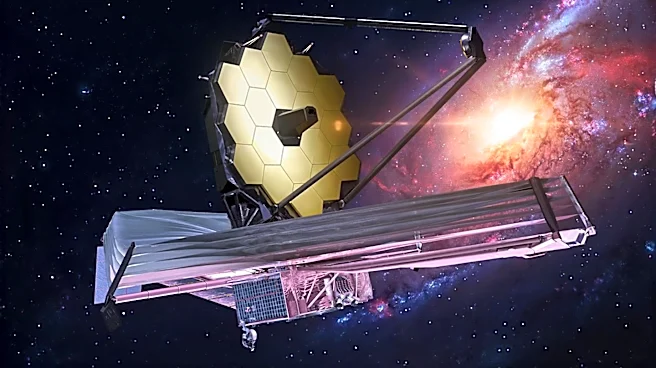
The James Webb Space Telescope (JWST) has observed a supernova that occurred just 730 million years after the Big Bang, during the epoch of reionization. This supernova, designated GRB 250314A, was initially detected by the SVOM satellite as a gamma-ray
burst. Subsequent observations by various telescopes confirmed its distance and age. The supernova's light took 13.1 billion years to reach Earth, providing a rare glimpse into the early universe. JWST's infrared capabilities allowed astronomers to confirm the supernova's characteristics, which appear similar to those of modern supernovae.
Why It's Important?
This observation is significant as it provides insights into the conditions of the early universe, particularly during the epoch of reionization when the first stars were forming. Understanding these early cosmic events helps astronomers piece together the history of the universe and the evolution of galaxies. The findings suggest that early supernovae may not differ significantly from those observed today, challenging assumptions about the early universe's unique conditions. This could lead to a reevaluation of models related to star formation and cosmic evolution.