
What's Happening?
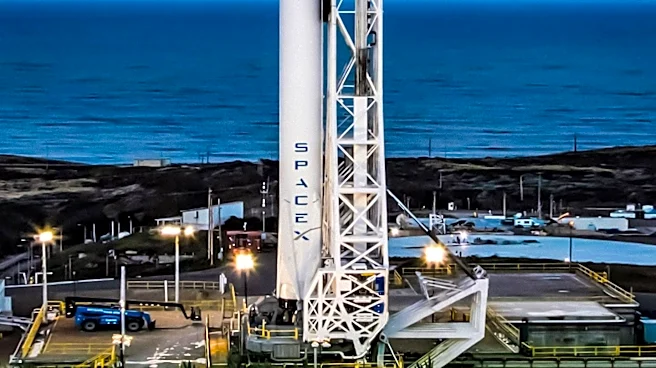
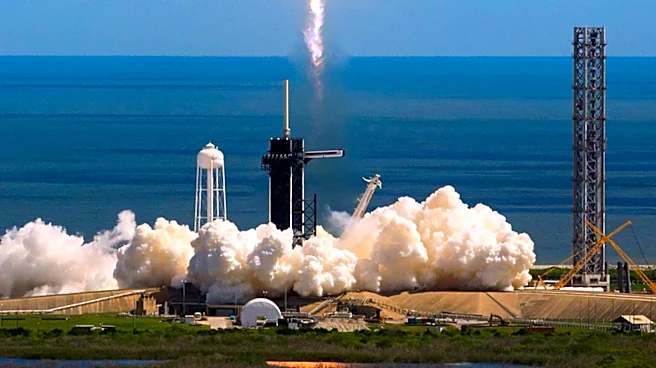
In the early hours of August 5, 2026, a defunct SpaceX Falcon 9 upper stage collided with the Moon at a speed of approximately 5,400 mph. The impact, which occurred near the Einstein crater on the Moon's
northwestern limb, was captured by South Korea's Danuri lunar orbiter. The Korea Aerospace Research Institute reported that Danuri completed eight imaging sessions, documenting the lunar surface before and after the collision. The images reveal a fresh, darkened scar at the impact site, indicating that dust and rock were ejected by the strike. This event has provided valuable data for studying impact dynamics and ejecta patterns, as unplanned lunar impacts are rare and seldom documented with such precision.
Why It's Important?
The incident highlights the growing issue of space debris and the lack of regulatory frameworks for the disposal of space objects beyond Earth's orbit. While the crash posed no danger to Earth, it raises questions about responsibility for deep-space debris. The data collected by Danuri is scientifically valuable, offering insights into high-velocity lunar impacts that would be costly to replicate intentionally. However, the event also underscores the need for clear end-of-life disposal standards for space objects to prevent similar occurrences in the future. The scientific community is divided, with some viewing the incident as a research opportunity and others as a preventable oversight.
What's Next?
NASA's Lunar Reconnaissance Orbiter is expected to conduct follow-up imaging of the impact site to refine crater-size estimates and enhance the analysis of the event. The timing of these images will depend on orbital passes and lighting conditions. The broader issue of space debris management remains unresolved, with ongoing discussions about establishing international regulations to address the disposal of space objects. The incident may prompt further dialogue among space agencies and stakeholders to develop comprehensive policies for managing space debris and preventing future collisions.
Beyond the Headlines
The event has ethical and legal implications, as it highlights the need for accountability in space exploration. The lack of a regulatory framework for deep-space debris raises questions about the responsibilities of private companies and governments in managing space objects. The incident also reflects the increasing complexity of space exploration, where scientific advancements must be balanced with environmental stewardship and international cooperation. As space exploration continues to expand, the development of sustainable practices will be crucial to ensure the long-term viability of space activities.