
What's Happening?
Physicists at the Australian National University have observed quantum entanglement in moving helium atoms, marking a significant advancement in testing quantum physics with massive particles. The experiment
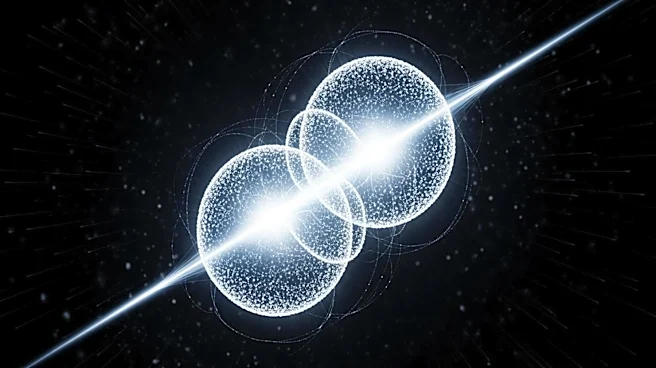
involved ultracold metastable helium atoms, which were split into different momentum states using laser pulses. As these atoms separated, they collided and produced spherical halos of scattered atom pairs, demonstrating entanglement tied to motion rather than spin or polarization. This discovery confirms that matter can exist in two locations simultaneously, challenging classical physics and providing a new testing ground for quantum mechanics.
Why It's Important?
This breakthrough pushes the boundaries of quantum physics by demonstrating nonlocal behavior in matter, not just light. It opens new avenues for testing quantum mechanics' connection with gravity and general relativity, potentially leading to a deeper understanding of fundamental forces. The ability to observe entanglement in massive particles could enhance quantum sensing and imaging technologies, offering precision beyond current limits. This research may also contribute to developing quantum information techniques using motional entanglement.
What's Next?
Future experiments will aim to perform a full CHSH-Bell inequality test, requiring independent phase settings in separate regions. This would further validate the observed entanglement and close remaining loopholes. Researchers will continue to refine their methods, improving correlation amplitudes and signal-to-noise ratios. The platform developed could facilitate studies on decoherence theories influenced by gravity and support quantum information applications.
Beyond the Headlines
The discovery has philosophical implications, challenging our understanding of reality and the nature of matter. It raises questions about the limits of classical intuition and the potential for quantum mechanics to redefine our perception of the universe. This could lead to broader discussions about the intersection of science and philosophy in exploring the fundamental nature of existence.