



What's Happening?
NASA has released its skywatching tips for July 2026, highlighting several celestial events. Key events include a predawn alignment of the Moon with Mars, Saturn, and Uranus on July 11 and 12, offering a spectacular view in the eastern sky. The New Moon on July 14
provides an optimal dark-sky window for observing Comet 10P/Tempel 2 and the Milky Way. Later in the month, Saturn's rings will be visible at a new angle, making them a rewarding target for telescope users. These events offer stargazers a chance to witness the dynamic nature of our solar system.
Why It's Important?
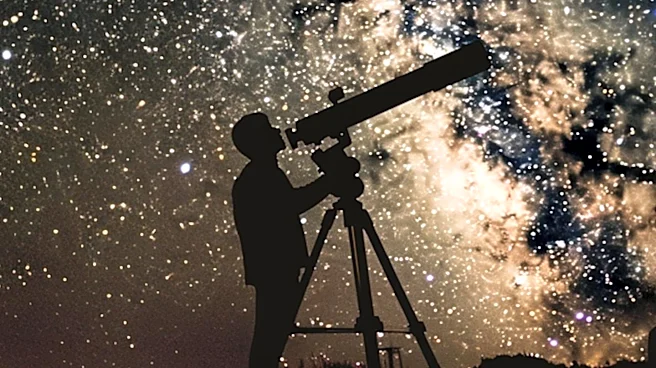
These celestial events provide an opportunity for both amateur and professional astronomers to engage with the night sky, fostering interest in astronomy and space science. Observing such phenomena can enhance public understanding of our solar system's dynamics and inspire future generations to pursue careers in science and technology. Additionally, these events can serve as educational tools, helping to illustrate the movements and interactions of celestial bodies.
What's Next?
As these events unfold, astronomers and enthusiasts will likely share observations and images, contributing to a broader understanding of these phenomena. Educational institutions and observatories may organize events to facilitate public viewing, enhancing community engagement with space science. The continued observation of these celestial events will also aid in refining astronomical models and predictions.