
What's Happening?
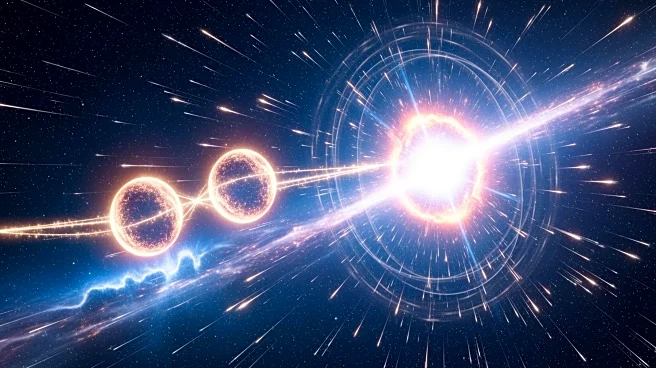
Astronomers are exploring the phenomenon of hypervelocity stars, which are stars moving at speeds sufficient to escape the Milky Way's gravitational pull. These stars are believed to originate from binary
systems interacting with the supermassive black hole Sagittarius A* or from supernovae in the Large Magellanic Cloud (LMC). When one star in a binary system explodes as a supernova, the companion star can be ejected at high speeds, contributing to the population of hypervelocity stars. This research provides insights into the dynamics of binary star systems and the effects of supernovae.
Why It's Important?
The study of hypervelocity stars enhances our understanding of stellar dynamics and the forces at play in our galaxy. By examining how binary systems interact with supermassive black holes and the aftermath of supernovae, astronomers can gain insights into the life cycles of stars and the mechanisms driving their movement. This research also contributes to our knowledge of the Milky Way's structure and the distribution of stars within it. Understanding these processes is crucial for developing comprehensive models of galactic evolution and the behavior of celestial bodies.
What's Next?
Further research is needed to confirm the origins of hypervelocity stars and to explore the implications of these findings for our understanding of galactic dynamics. Astronomers will continue to study binary systems and supernovae to refine models of star ejection and movement. The development of advanced telescopes and observational techniques will aid in identifying and analyzing hypervelocity stars, providing more data to support or challenge current theories. This ongoing research will contribute to a deeper understanding of the complex interactions within our galaxy.