
What's Happening?
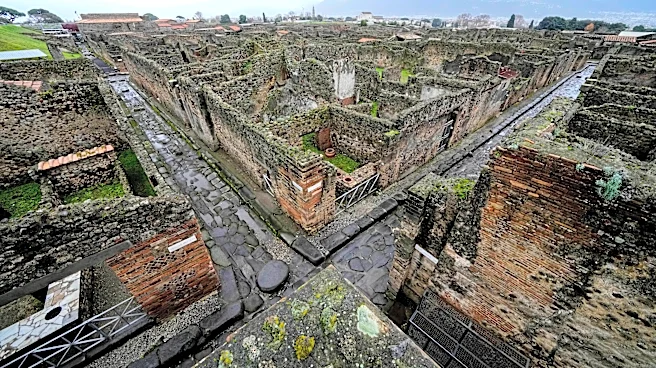
Archaeologists at the ancient Roman site of Pompeii have utilized artificial intelligence to digitally reconstruct the face of a victim from the AD 79 eruption of Mount Vesuvius. This marks the first time
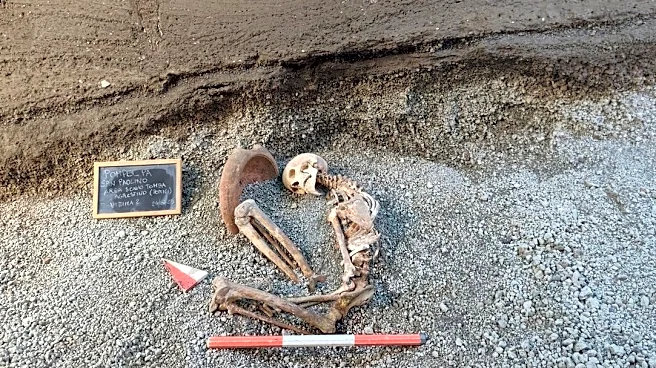
AI has been used in such a manner at Pompeii, providing a novel approach to understanding the catastrophic event. The digital portrait represents an older man who was among two victims discovered attempting to flee the city. Researchers believe he died during a heavy fall of volcanic debris. The reconstruction was developed by the Pompeii Archaeological Park in collaboration with the University of Padua, based on archaeological survey data from excavations near the Porta Stabia necropolis. The victim was found holding a terracotta mortar, likely used to shield his head from falling volcanic stones, and carrying personal items such as an oil lamp, a small iron ring, and 10 bronze coins.
Why It's Important?
The use of artificial intelligence in archaeology, as demonstrated by this project, represents a significant advancement in the field. It allows for a more detailed and emotionally engaging understanding of historical events, potentially transforming how archaeological data is interpreted and presented to the public. This approach not only enhances the scientific study of ancient sites but also makes the findings more accessible to a broader audience. The project underscores the potential of AI to renew classical studies and improve the preservation and enhancement of vast archaeological data. By providing a realistic human likeness of historical figures, AI can deepen public engagement and interest in ancient history.
What's Next?
The success of this AI application in Pompeii may lead to its adoption in other archaeological projects worldwide. Researchers and archaeologists might explore further collaborations with technology experts to apply similar techniques to other historical sites. This could result in a broader use of AI in reconstructing historical events and figures, potentially leading to new discoveries and insights. Additionally, the project may inspire educational initiatives aimed at integrating AI technology into the study of history and archaeology, fostering a new generation of scholars equipped with advanced tools for historical analysis.