





What's Happening?
A U.S. Army flight simulator located at the U.S. Army Garrison Ansbach’s Storck Barracks in Illesheim, Germany, is providing crucial training for NATO’s aviation community. This facility, known as the Illesheim Flight Simulator Complex (IFSC), is operated
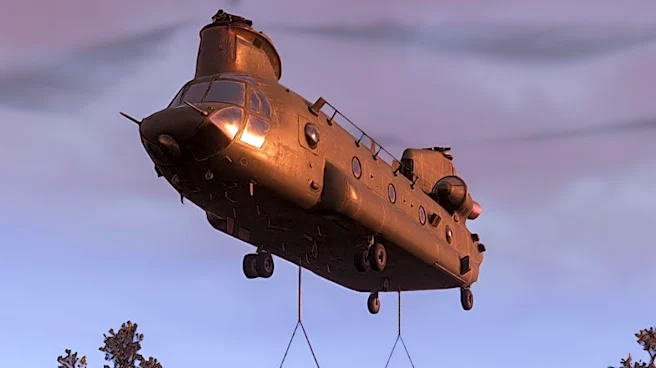
by U.S. Army Europe and Africa. It is currently being utilized by German Air Force pilots to prepare for the German Armed Forces' acquisition of 60 CH-47F Block II Chinook helicopters, expected to be fielded by fall 2027. Two German Air Force pilots, part of the initial cohort for the new aircraft, recently trained at the IFSC. The simulator allows pilots to practice various scenarios, including emergency procedures, challenging landings, and extreme weather operations, in a safe environment. The German pilots also received training at the U.S. Army Aviation Center of Excellence at Fort Rucker, Alabama, which is the Army’s largest helicopter training institution. Starting in 2028, German Air Force aviators will annually attend Fort Rucker for initial helicopter training and CH-47 qualification.
Why It's Important?
This collaboration is significant for strengthening NATO's collective defense capabilities and interoperability. By providing advanced flight simulation training to German pilots, the U.S. Army is directly contributing to Germany's ability to enhance its heavy-lift and transport capabilities with the new CH-47F Chinook fleet. This initiative reduces the need for NATO partners to invest in building their own simulator complexes, thereby cutting costs and optimizing resource allocation. The training at IFSC and Fort Rucker ensures that German forces are well-prepared to operate sophisticated U.S.-made aircraft, fostering greater standardization and coordination within NATO aviation. The long-term impact includes a more cohesive and capable NATO alliance, better equipped to respond to various security challenges, and a deeper strategic partnership between the U.S. and Germany in defense matters. This also highlights the U.S. commitment to supporting its allies through shared training and technological resources.
What's Next?
The German Armed Forces are set to field their CH-47F Block II Chinook helicopters by fall 2027. Following this, German Air Force aviators will begin annual training at Fort Rucker, Alabama, starting in 2028, for initial helicopter training and CH-47 qualification. The German Air Force plans to staff over 200 trained pilots for its future Chinook fleet, indicating a sustained need for ongoing training and collaboration with U.S. Army facilities. The IFSC will continue to prioritize U.S. Army soldiers but will also support pilots from at least five other NATO partners, suggesting a continued role as a regional training hub. Future developments may include further integration of simulator software to better match Bundeswehr aircraft configurations, potentially streamlining the transition for German pilots. The success of this program could also serve as a model for similar cooperative training initiatives with other NATO allies.
Beyond the Headlines
The use of U.S. Army facilities in Europe for training NATO allies like Germany underscores a broader strategy of burden-sharing and collective security within the alliance. This approach not only enhances military readiness but also fosters deeper diplomatic and strategic ties. The cost-saving aspect for NATO partners, by utilizing existing U.S. infrastructure, highlights an efficient use of resources that can be reinvested into other critical defense areas. Furthermore, the training collaboration helps to standardize operational procedures and communication protocols, which are vital during joint military operations. This initiative also reflects the evolving nature of modern warfare and defense, where advanced simulation technology plays a crucial role in preparing personnel for complex scenarios without the risks and costs associated with actual flight hours. The long-term cultural and professional exchange between U.S. and German military personnel through these training programs can also build lasting relationships and mutual understanding.