



What's Happening?
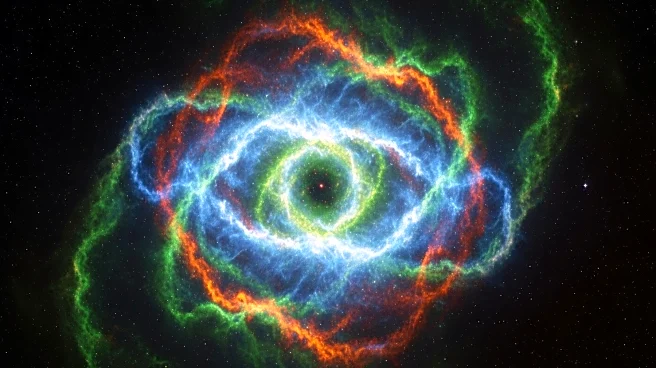
The James Webb Space Telescope (JWST) has captured a stunning image of the Helix Nebula, also known as the 'Eye of God,' located 655 light-years away in the constellation Aquarius. This planetary nebula, formed by the ejection of gas and dust from a dying
sunlike star, showcases vibrant colors and intricate structures. The JWST's near-infrared capabilities have revealed comet-like knots and stellar winds within the nebula, providing a detailed view of the processes involved in the death of a star. The image highlights the nebula's role in seeding the galaxy with elements essential for life, such as carbon, oxygen, and nitrogen.
Why It's Important?
The Helix Nebula image offers a glimpse into the future of our own solar system, as it represents the fate of sunlike stars. Understanding the life cycle of stars and the formation of planetary nebulas is crucial for comprehending the evolution of galaxies and the distribution of elements necessary for life. The JWST's observations enhance our knowledge of cosmic processes and contribute to the broader field of astrophysics. This research has implications for the study of star formation, the chemical enrichment of the universe, and the potential for life beyond Earth.