
What's Happening?
An international team of astronomers has reported a significant discovery involving two black holes and a star, which was caught in a gravitational tug-of-war. This event, observed as a faint X-ray signal, is believed to have occurred approximately 3
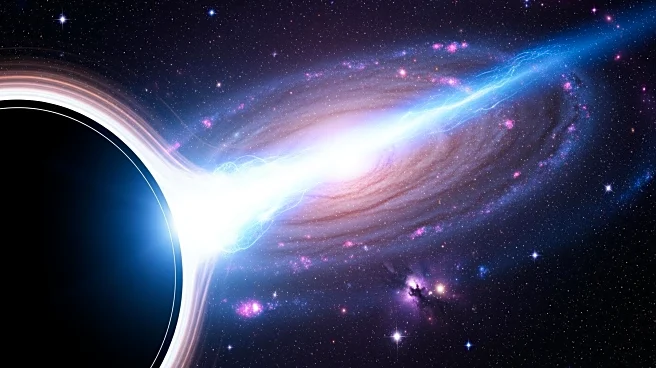
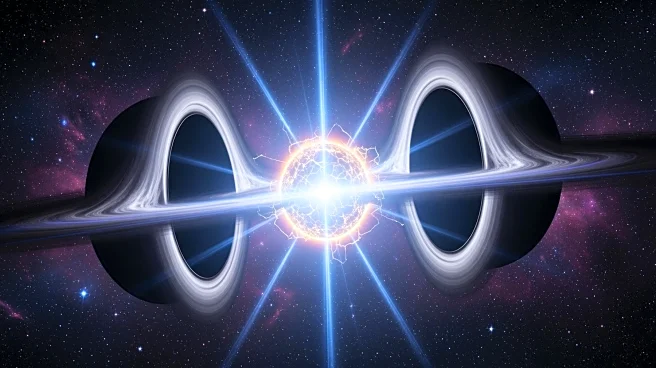
billion years ago. The star, named XID 925, was initially detected in 1999 during the Chandra X-ray Observatory's Deep Field South survey. Over the years, astronomers have monitored this X-ray source, noting its dramatic fluctuations in brightness. The recent study suggests that the star was first torn apart by a supermassive black hole, forming an accretion disk. Subsequently, a second black hole interacted with this disk, causing a surge in X-ray emissions. This phenomenon, known as a tidal disruption event (TDE), provides insights into the interactions between stars and black holes.
Why It's Important?
This discovery is significant as it represents one of the most distant and faintest known tidal disruption events, offering a rare glimpse into the dynamics of black holes and their impact on surrounding celestial bodies. Understanding such events can enhance our knowledge of galaxy formation and the role of black holes in the universe. The observation of two black holes interacting with a single star is particularly noteworthy, as it challenges existing models of TDEs and suggests more complex gravitational interactions. This research could lead to advancements in astrophysics, particularly in understanding the lifecycle of stars and the evolution of galaxies.
What's Next?
Future research will likely focus on confirming the details of this event and exploring similar occurrences in other parts of the universe. Astronomers may use advanced telescopes and observational techniques to identify more instances of binary black hole interactions. Additionally, this discovery could prompt theoretical studies to refine models of black hole behavior and their influence on galactic environments. The findings may also inspire further exploration of the role of black holes in cosmic evolution, potentially leading to new insights into the fundamental processes governing the universe.