
What's Happening?
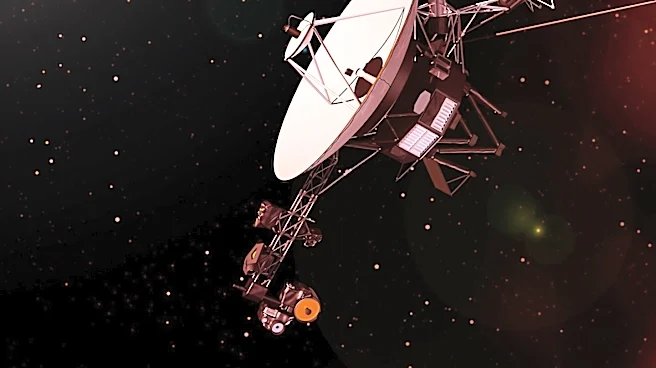
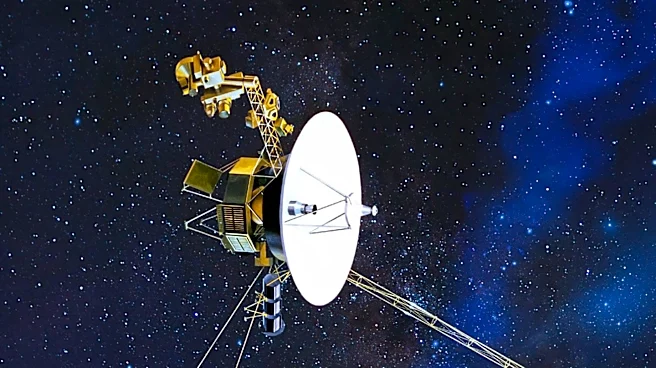
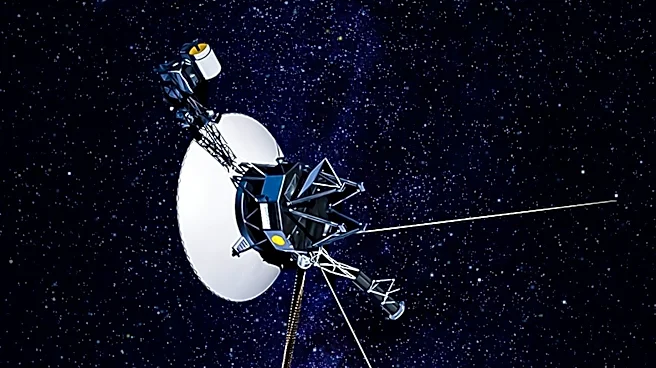
Voyager 2, a NASA spacecraft, achieved a remarkable feat by arriving at Neptune within 100 kilometers of its target after a 12-year journey covering over seven billion kilometers. This precision is likened
to sinking a golf putt from 3,630 kilometers away. The spacecraft's flyby of Neptune in 1989 revealed significant discoveries, including six new moons, four rings, and the Great Dark Spot. Voyager 2's trajectory was meticulously planned to use Neptune's gravity to redirect it towards its largest moon, Triton, which was found to have active geysers and the coldest natural surface measured by Voyager. The mission's success was a result of careful navigation, gravity assists, and communication enhancements, such as expanding NASA's Deep Space Network. Despite the success, no spacecraft has returned to Neptune or Triton since, leaving the 1989 flyby as the only close examination of these celestial bodies.
Why It's Important?
Voyager 2's flyby of Neptune represents a landmark achievement in space exploration, showcasing the capabilities of human engineering and navigation over vast distances. The mission's discoveries have expanded our understanding of the outer planets and their moons, providing insights into the dynamics of ice giants and their atmospheres. The precision of Voyager 2's navigation underscores the potential for future deep-space missions to explore distant worlds with similar accuracy. The data collected from Neptune and Triton continues to inform scientific research, particularly as exoplanet studies reveal that many discovered planets are similar in size to Uranus and Neptune. The mission's success highlights the importance of international collaboration and technological advancements in space exploration, setting a precedent for future missions to the outer solar system.
What's Next?
The scientific community continues to advocate for a return mission to Neptune or Uranus, driven by the need to study ice giants more comprehensively. The 2023-2032 planetary science decadal survey prioritizes a Uranus Orbiter and Probe, reflecting the growing interest in these types of planets. However, such missions require significant funding and international cooperation, and are unlikely to launch for several years. In the meantime, researchers will continue to analyze Voyager 2's data and explore new technologies to enhance future missions. The success of Voyager 2 serves as a reminder of the potential for groundbreaking discoveries in the outer solar system, encouraging continued investment in space exploration.