



What's Happening?
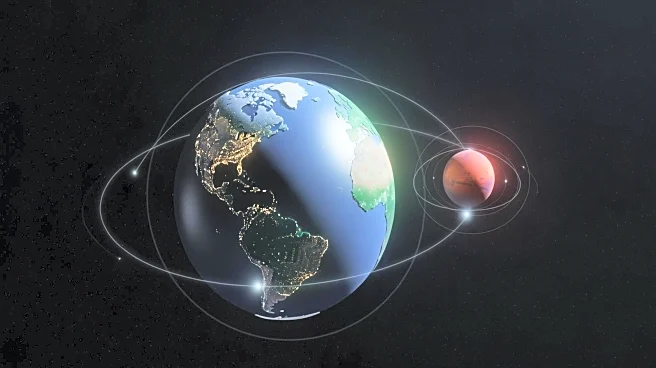
Recent research led by astronomer Stephen Kane, published on ArXiv, has uncovered that Mars plays a significant role in shaping Earth's climate through its gravitational pull. The study highlights that Mars' gravitational influence affects Earth's climate rhythms,
including the timing of ice ages and the length of seasons. By simulating changes in Mars' mass, the research team discovered that the planet's gravitational force is crucial for the 100,000-year cycles associated with glacial and interglacial periods. These cycles become more pronounced when Mars is larger, and they disappear entirely when Mars' mass is reduced. The study also found that Mars impacts Earth's axial tilt, which determines the length of seasons, suggesting that changes in Mars' mass could lead to significant shifts in Earth's climate patterns.
Why It's Important?
The findings of this study have profound implications for our understanding of Earth's climate system. Traditionally, Earth's climate has been attributed mainly to its relationship with the Sun. However, this research suggests that neighboring planets, particularly Mars, also play a critical role. The gravitational influence of Mars on Earth's climate cycles could help explain historical climate variations and provide insights into future climate changes. This understanding is crucial for climate scientists and policymakers as they work to predict and mitigate the impacts of climate change. The study also underscores the interconnectedness of planetary systems, highlighting the need for a broader perspective in climate science that considers extraterrestrial influences.
What's Next?
The study opens new avenues for research into the gravitational interactions between planets and their impact on climate systems. Future research could explore how other planets in the solar system might influence Earth's climate and whether similar interactions occur in other planetary systems. Additionally, the findings could inform climate models, leading to more accurate predictions of future climate scenarios. As the scientific community continues to explore these dynamics, there may be increased interest in planetary science and its implications for understanding Earth's climate.
Beyond the Headlines
This research highlights the complex and interconnected nature of planetary systems, challenging the traditional view that Earth's climate is solely influenced by solar interactions. The study suggests that even small changes in a planet's mass can have significant ripple effects on another planet's climate, emphasizing the delicate balance of forces that govern planetary environments. This understanding could lead to a reevaluation of how we study climate systems, incorporating a more holistic approach that considers both terrestrial and extraterrestrial factors.