




What's Happening?
A federal judge in Oklahoma, U.S. District Court Judge David L. Russell, has granted a preliminary injunction allowing a proposed Jewish charter school, National Ben Gamla Jewish Charter School Foundation, to proceed despite the nonsectarian requirement
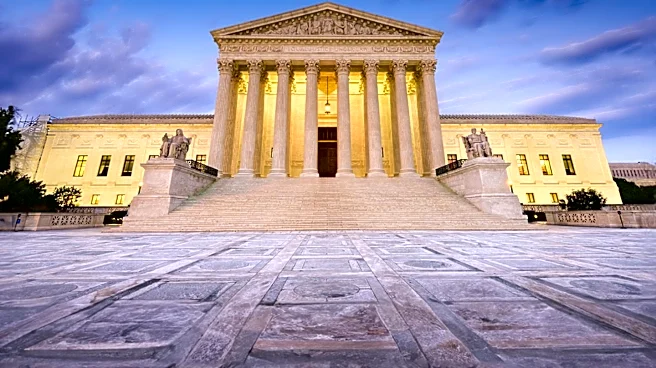
of the Oklahoma Charter Schools Act. The ruling, issued on Thursday, states that the nonsectarian provision in the state law discriminates against otherwise eligible recipients solely due to their religious character, thereby violating the Free Exercise Clause of the First Amendment. This decision directly conflicts with a 2024 Oklahoma Supreme Court ruling in Drummond v. Oklahoma Statewide Virtual Charter School Board, which blocked the proposed St. Isidore Catholic Charter School. The U.S. Supreme Court had previously left the Oklahoma Supreme Court's decision in place after a 4-4 ruling in 2025, with Justice Amy Coney Barrett recusing herself from the case. Attorneys representing the Ben Gamla foundation and the Statewide Charter School Board, who supported the school's position, celebrated the ruling as a victory for educational freedom and religious equality.
Why It's Important?
This ruling is highly significant as it reignites the national debate over the separation of church and state in public education and the interpretation of the First Amendment's Free Exercise and Establishment Clauses. By allowing a religious charter school to receive public funding, the decision challenges the long-standing principle that public funds should not flow to religious institutions, a concept enshrined in many state constitutions, including Oklahoma's. The conflict between the federal court's decision and the Oklahoma Supreme Court's prior ruling creates a direct legal clash that is likely to escalate to higher courts, potentially the U.S. Supreme Court. This case could set a precedent for how religious organizations can participate in publicly funded educational programs across the U.S., impacting the landscape of charter schools and religious freedom. It also highlights the differing judicial interpretations of what constitutes a 'public' school and whether such entities can maintain a religious character while receiving state support. The outcome will affect not only religious groups seeking to establish charter schools but also public education advocates concerned about the commingling of state funds and religious instruction.
What's Next?
The preliminary injunction is expected to face an appeal, with defendant-intervenors having 30 days to appeal to the 10th Circuit U.S. Court of Appeals. Legal experts, including attorneys involved in the case, anticipate that the dispute will ultimately reach the U.S. Supreme Court, especially given the previous 4-4 split on a similar case involving a Catholic charter school in Oklahoma. The resolution of this case at the Supreme Court level could potentially break the previous tie and establish a definitive national standard regarding religious charter schools and public funding. The outcome will have broad implications for educational policy, religious freedom, and the interpretation of constitutional law across the U.S. Stakeholders, including religious organizations, public education advocates, and civil liberties groups, will closely monitor the appeals process, as the final decision could reshape the future of charter schools and the role of religion in publicly funded education.
Beyond the Headlines
The deeper implications of this case extend beyond legal precedent to the societal and cultural fabric of the U.S. The debate over religious charter schools touches on fundamental questions about religious pluralism, educational choice, and the role of government in fostering diverse educational environments. If religious charter schools become more widespread, it could lead to increased fragmentation of the public education system, potentially creating schools that cater to specific religious doctrines rather than a broad, secular curriculum. This raises ethical concerns about potential indoctrination, discrimination against students and families who do not share the school's beliefs, and the equitable distribution of public resources. The case also highlights the ongoing tension between individual religious freedom and the collective interest in maintaining a secular public sphere. The long-term shift could see a redefinition of what constitutes 'public' education, moving towards a model where religious institutions play a more direct role in state-funded schooling, with significant consequences for social cohesion and the protection of minority rights within educational settings.