



What's Happening?
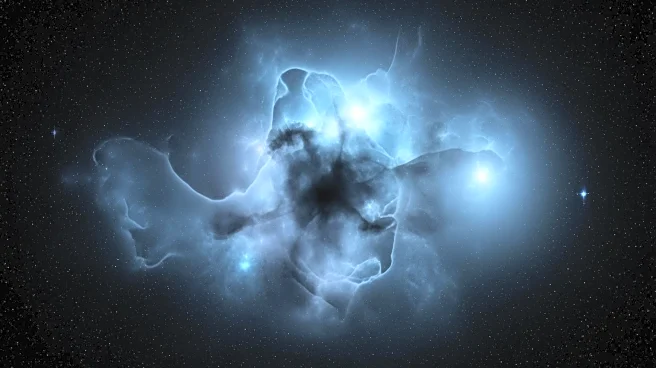
NASA's Hubble Space Telescope has discovered a unique space object named 'Cloud-9', located 14 million light-years from Earth. This starless, gas-rich cloud is believed to be a relic of early galaxy formation and represents the first confirmed detection
of such an object. The discovery, presented at the 247th meeting of the American Astronomical Society, provides new insights into the dark components of the universe, particularly dark matter, which is difficult to detect as it does not emit light. Cloud-9 is associated with the nearby spiral galaxy Messier 94 and is composed primarily of neutral hydrogen. The findings suggest the potential existence of other 'failed galaxies' and offer a rare glimpse into the early universe and the nature of dark matter.
Why It's Important?
The discovery of Cloud-9 is significant as it enhances the understanding of galaxy formation and the early universe. It provides a rare opportunity to study dark matter, which constitutes most of the universe's mass but remains largely undetectable. This finding could lead to the identification of more 'failed galaxies', offering insights into the universe's dark components that are not visible through conventional observations. The research could also inform future surveys and studies, potentially leading to breakthroughs in understanding the physics of dark matter and the processes that govern galaxy formation.