





What's Happening?
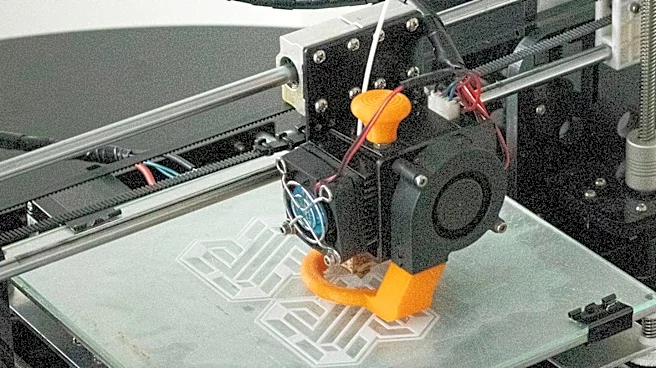
Canadian engineers have innovatively repurposed the mouthparts of dead mosquitoes to serve as tiny 3D printer nozzles, a development that earned them the Ig Nobel Technology Prize. This technique, termed 'necroprinting,' involves using the mosquito's
proboscis—its needle-like mouthpart—to extrude ink and construct miniature structures layer by layer. The research, published in 'Science Advances,' demonstrated that these biological nozzles could produce lines approximately 18 to 28 micrometers wide. The mosquito proboscis was found to be incredibly small, relatively straight, and strong enough to withstand printing pressures of about 708 kilopascals before rupturing. Furthermore, these nozzles proved to be remarkably low-cost, less than 2 cents per mosquito, and could remain usable for at least nine days at room temperature or over a year when frozen. The engineers successfully printed various structures, including a honeycomb pattern and a maple leaf shape, and even created a scaffold containing living cancer cells and red blood cells, with over 86% cell survival.
Why It's Important?
This pioneering use of mosquito mouthparts for 3D printing opens new avenues in microscopic printing and bioprinting research. The ability to create extremely fine structures with such precision and at a low cost could significantly impact fields requiring micro-scale fabrication, such as medical technology and advanced materials science. For bioprinting, the successful printing of living cells with high viability suggests potential for creating more realistic models of human tissues for disease study and drug testing. This innovation also highlights a broader trend of biomimicry in engineering, where natural designs inspire technological solutions. The cost-effectiveness and biodegradability of these biological nozzles offer advantages over traditional, more expensive, and brittle glass-pulled tips, potentially democratizing access to advanced micro-printing capabilities for researchers globally.
What's Next?
The research team will likely continue to explore the full capabilities and limitations of 'necroprinting,' including optimizing printing parameters and investigating the range of materials that can be extruded through these biological nozzles. Further studies may focus on refining the resolution and durability of the mosquito-based nozzles to compete with or complement existing micro-printing technologies. The application of this technique in bioprinting, particularly for creating complex tissue models, is a promising area for future development. Researchers may also investigate other insect-derived biological components for similar innovative applications, expanding the scope of biomimicry in advanced manufacturing. The broader scientific community will be watching to see how this novel approach can be integrated into existing research and industrial processes.
Beyond the Headlines
The 'necroprinting' innovation transcends mere technological advancement; it represents a profound shift in how we perceive and utilize biological resources. By transforming a common pest into a sophisticated tool, the engineers challenge conventional notions of waste and utility. This approach could foster a more sustainable paradigm in manufacturing, where biological components, often discarded, are re-evaluated for their inherent structural and functional properties. The ethical implications of using animal parts, even from dead insects, for technological purposes might also spark discussions about the boundaries of biomimicry and resource exploitation. Ultimately, this research underscores the vast, untapped potential within the natural world to inspire and provide solutions for complex scientific and engineering challenges, pushing the boundaries of what is considered possible in micro-fabrication and bioprinting.