
What's Happening?
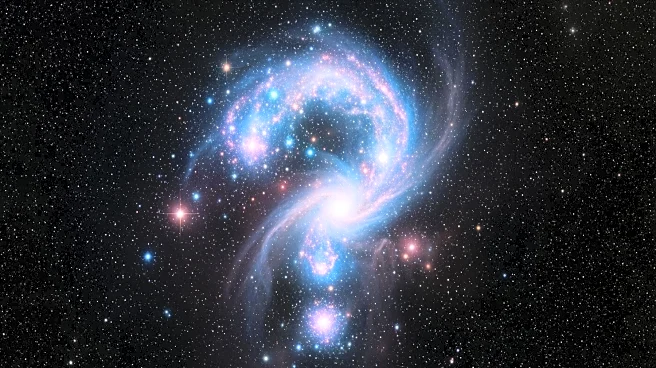
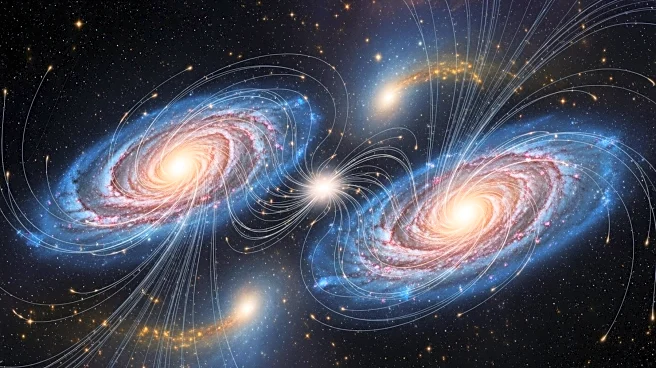
Astronomers have mapped a 'magnetic superhighway' in the merging galaxy system Arp 220, using the Atacama Large Millimeter/submillimeter Array (ALMA). This system, located 250 million light-years from
Earth, is an ultraluminous infrared galaxy formed by the merger of two spiral galaxies. The study revealed that magnetic fields play a central role in launching and shaping powerful galactic winds, which travel at 1.1 million miles per hour. These winds carry gas, dust, and cosmic rays beyond the galaxy, challenging previous assumptions that such outflows were driven mainly by star formation and black hole activity.
Why It's Important?
The discovery of strong, organized magnetic fields in Arp 220 provides new insights into the role of magnetism in galaxy formation and evolution. These fields influence how gas moves and cools, affecting star formation and the enrichment of intergalactic space. The findings suggest that similar magnetic structures may have been common in the early universe, impacting the development of galaxies. Understanding these processes is crucial for comprehending the dynamics of galaxy mergers and the distribution of matter in the cosmos.
Beyond the Headlines
The study highlights the potential for magnetic fields to guide and accelerate material in galactic outflows, a factor that could significantly alter our understanding of galaxy dynamics. The presence of a magnetized bridge of dust connecting the galactic centers suggests that magnetic fields may facilitate the transfer of material during mergers. This research opens new avenues for exploring the interplay between gravity, star formation, and magnetism in shaping galaxies.