



What's Happening?
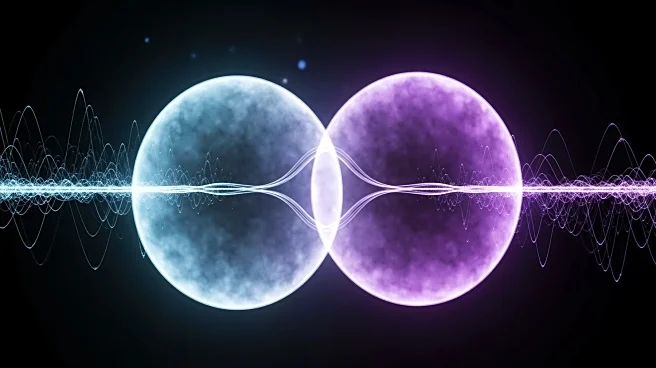
Researchers at RPTU University of Kaiserslautern-Landau have successfully simulated the Josephson effect using Bose-Einstein condensates (BECs), demonstrating the universal nature of Shapiro steps. By separating two BECs with a thin optical barrier and applying
microwave radiation, the team replicated the conditions of a superconducting Josephson junction. This experiment allowed the observation of Shapiro steps, which are quantized voltage plateaus used to calibrate electrical voltage. The study, published in Science, highlights the potential of quantum simulation to explore complex quantum systems that are otherwise difficult to observe directly.
Why It's Important?
This research bridges the gap between quantum mechanics and practical applications, providing insights into the fundamental processes of superconductors. The ability to simulate and observe quantum phenomena in a controlled environment could lead to advancements in quantum computing and precision measurement technologies. Understanding these processes at a microscopic level is crucial for developing new technologies that rely on quantum mechanics, such as quantum computers and advanced sensors. The study also emphasizes the versatility of quantum simulation as a tool for exploring and understanding complex quantum systems.
What's Next?
The research team plans to expand their work by connecting multiple BEC-based 'building blocks' to create atomic circuits, a field known as 'atomtronics.' This could lead to the development of new quantum devices and technologies that utilize atoms instead of electrons. Further research will focus on replicating other fundamental electronic components using atoms, potentially leading to breakthroughs in quantum technology and materials science.