








What's Happening?
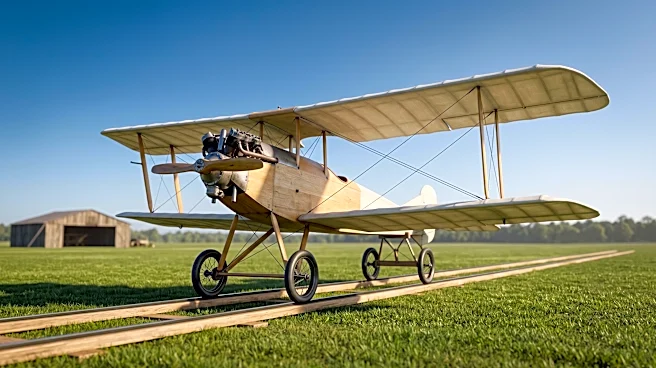
The U.S. Army was experimenting with armed unmanned aerial vehicles (UAVs) as far back as World War I, a period much earlier than commonly perceived for drone warfare. This early effort involved the Kettering Aerial Torpedo, nicknamed 'the Bug,' which
was a pilotless wooden biplane designed to carry 180 pounds of high explosives. Developed by Charles F. Kettering, the Bug was propelled by a 40-horsepower 4-cylinder engine and launched from a four-wheeled dolly off a portable rail track. Despite its innovative design and the potential to transform combat, the Bug faced challenges during testing. A demonstration flight in Dayton saw the Aerial Torpedo fly off-course and nearly crash into a reviewing stand of U.S. Army brass. Nevertheless, the officers were sufficiently impressed to continue funding its development and testing. The Dayton-Wright Airplane Company produced fewer than 50 Bugs before the Armistice in November 1919, but none were ultimately deployed on the Western Front. This initiative occurred just 14 years after the Wright Flyer's maiden flight, highlighting the rapid advancements in aerial technology during that era.
Why It's Important?
This historical revelation underscores the long-standing interest and early investment by the U.S. military in unmanned aerial technology, predating modern perceptions of drone warfare by decades. It demonstrates that the concept of autonomous weapons systems is not a recent phenomenon but has roots in the early 20th century. The U.S. Army's exploration of the Kettering Aerial Torpedo during World War I highlights a continuous strategic pursuit of technological advantage in warfare. This early experimentation, even if unsuccessful in deployment, laid foundational ideas for future drone development and the integration of unmanned systems into military doctrine. Understanding this historical context is crucial for appreciating the evolution of military technology and the persistent drive to innovate in defense, influencing current and future procurement strategies for advanced weaponry. The challenges faced by the Bug also illustrate the inherent difficulties in developing and deploying cutting-edge military technology, a lesson that remains relevant today.
What's Next?
While the Kettering Aerial Torpedo itself did not see combat, its development marked a significant, albeit early, step in the U.S. military's journey with unmanned aerial vehicles. The lessons learned from its testing, including the challenges of reliability and control, likely informed subsequent research and development in aviation and autonomous systems. The shelving of the Bug's development in the 1920s coincided with the U.S. Army Air Service officers advocating for an independent Air Force, indicating a broader shift in military aviation strategy. This historical precedent suggests a continuous cycle of innovation, testing, and adaptation in military technology. Future developments will likely continue to build on these early concepts, pushing the boundaries of autonomy, precision, and cost-effectiveness in drone warfare, as seen in contemporary efforts to rapidly deploy and adapt drone technologies in modern conflicts.
Beyond the Headlines
The story of the Kettering Aerial Torpedo offers a deeper insight into the philosophical and practical challenges of integrating new technologies into warfare. The near-crash incident during its demonstration highlights the inherent risks and the need for rigorous testing and safety protocols, issues that remain paramount in today's advanced drone operations. Furthermore, the early pursuit of unmanned systems reflects a persistent military objective: to project power and achieve objectives while minimizing human risk. This early attempt to create a 'pilotless' weapon foreshadows contemporary debates about autonomous weapons systems and the ethical implications of removing human operators from the immediate battlefield. The Bug's existence also illustrates how technological advancements, even those that don't immediately succeed, can shape long-term strategic thinking and contribute to the eventual emergence of entirely new forms of warfare.