





What's Happening?
Edward Oughton, an associate professor at George Mason University's College of Science, has been awarded two grants from the National Science Foundation (NSF). The first grant, totaling $499,837, is for developing an AI-enabled framework to characterize
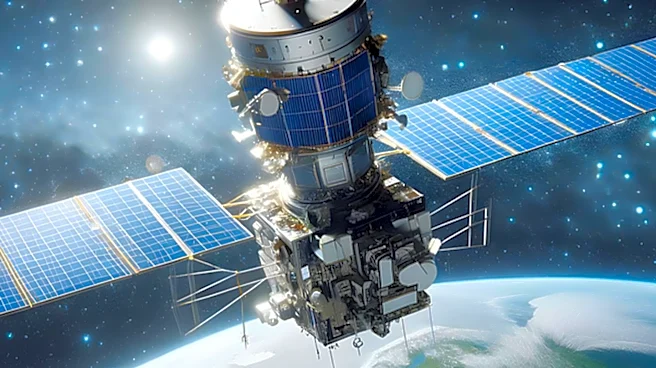
and mitigate space weather risks for satellite operations. This research aims to translate uncertainties in space weather forecasts into actionable risk information, similar to terrestrial weather prediction. The second grant, for $49,357, was awarded to Oughton as co-PI with Alexander Sprintson, and will support a workshop focused on identifying critical gaps and developing a research agenda for improving cybersecurity in space and non-terrestrial networks. These initiatives are designed to enhance the resilience of satellite networks against events like geomagnetic storms and address the increasing frequency and sophistication of cyberattacks on satellites. The research will combine multiple data sets into machine learning and physics-based models to refine predictions of geomagnetic storm occurrences, timing, severity, and their impacts on space infrastructure, the economy, and society.
Why It's Important?
The reliance of modern society on satellite networks for critical services such as television broadcasts, internet connectivity, cell phone service, GPS, defense, and weather forecasting makes these grants particularly significant. Space weather events can range from minor signal interference to catastrophic satellite damage, costing companies hundreds of millions of dollars and disrupting essential infrastructure. Accurate forecasting and robust cybersecurity measures are crucial to protect these vital systems. The development of an end-to-end framework for space weather risk assessment will provide critical infrastructure operators with reliable forecasts, enabling them to design more resilient systems. Furthermore, the workshop on space cybersecurity will bring together experts to address the rapidly evolving threat landscape, which has expanded due to the proliferation of global satellite constellations. This research directly impacts national security, economic stability, and the continued advancement of space exploration, as reliable space infrastructure is essential for future endeavors like lunar missions and beyond.
What's Next?
The nearly $500,000 grant will fund the development of the first end-to-end framework for translating space weather forecast uncertainty into actionable risk information for satellite operations. This foundational research will involve combining various data sets with machine learning and physics-based models to improve predictions of geomagnetic storms and their impacts. The educational component of the grant will also ensure the involvement of the next generation of scientists and engineers, with high school students participating in the Aspiring Scientists Summer Internship Program (ASSIP) to contribute to this critical foundation. The second grant will facilitate a workshop bringing together researchers from academia, industry, and government. This workshop aims to identify key challenges and establish a research agenda to enhance the cybersecurity of space and non-terrestrial networks. The outcomes of these initiatives are expected to lead to more resilient space infrastructure and improved preparedness for both natural and man-made threats in space.
Beyond the Headlines
These NSF grants highlight a growing recognition of the interconnectedness between space phenomena, technological infrastructure, and societal well-being. Beyond the immediate practical applications of improved space weather forecasting and cybersecurity, this research touches upon the ethical considerations of protecting critical global infrastructure in an increasingly contested domain. The involvement of high school students through the ASSIP program also underscores a long-term investment in STEM education, fostering a pipeline of talent crucial for addressing future challenges in space science and technology. The interdisciplinary approach, combining geography, geoinformation science, electrical engineering, and computer science, demonstrates a shift towards holistic problem-solving for complex extraterrestrial challenges. This integrated scientific and engineering modeling aims to move beyond crude assumptions, linking scientific advancements directly to impacts on the population and businesses, thereby influencing policy decisions and industrial standards for space operations.