





What's Happening?
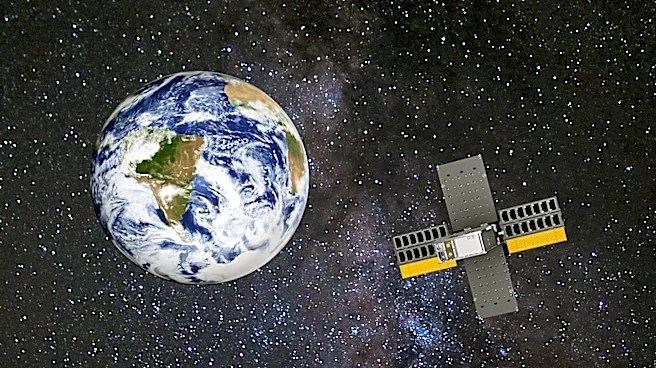
The concept of traveling at the speed of light remains a theoretical challenge due to the immense energy required for objects with mass. Current physics, based on relativity, dictates that as an object approaches light speed, the energy needed increases
exponentially, making it impossible to reach or exceed this speed. Recent discussions have explored the potential of near-light-speed travel through concepts like Breakthrough Starshot, which proposes using laser-driven sails to propel small probes to 20% of light speed. However, these ideas remain largely theoretical due to unresolved engineering challenges.
Why It's Important?
Understanding the limitations and possibilities of light-speed travel is crucial for future space exploration. While current technology is far from achieving such speeds, theoretical advancements could pave the way for new propulsion methods, potentially revolutionizing space travel. This could lead to faster interstellar missions, expanding our ability to explore distant star systems. The pursuit of these technologies also drives innovation in related fields, such as materials science and energy generation, with potential applications beyond space exploration.
Beyond the Headlines
The exploration of light-speed travel touches on fundamental questions about the nature of the universe and our place within it. It challenges scientists to rethink the boundaries of physics and explore new realms of possibility. The pursuit of these ideas also raises ethical and philosophical questions about the implications of interstellar travel, such as the potential impact on extraterrestrial environments and the long-term survival of humanity.