





What's Happening?
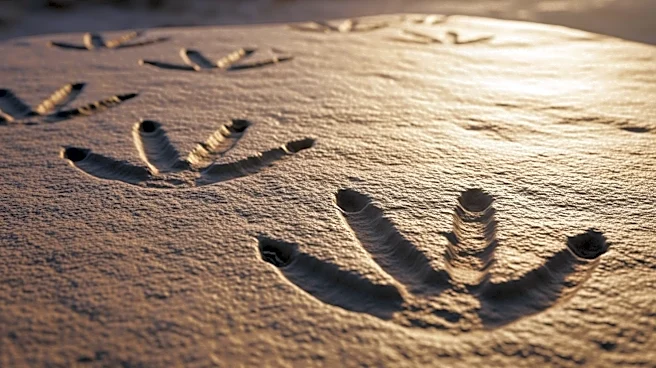
A rock that had been sitting unnoticed in a Queensland school for over 20 years has been discovered to contain 66 dinosaur footprints, marking one of the highest concentrations of such tracks in Australia. The boulder, originally from the Callide Mine
near Biloela, was placed in the school's foyer where it went largely ignored until community members noticed its similarity to nearby fossils. A team from the University of Queensland confirmed the significance of the find, which is crucial as Australia lacks confirmed dinosaur bones from the Early Jurassic period. The footprints, attributed to the Anomoepus scambus species, suggest a group of at least 47 dinosaurs once traversed the area, likely near a water source.
Why It's Important?
This discovery is significant as it provides rare evidence of dinosaur activity in Australia during the Early Jurassic period, a time from which no bones have been found in the region. The footprints offer valuable insights into the behavior and movement of these ancient creatures, contributing to the understanding of prehistoric life. The find underscores the importance of re-examining overlooked artifacts and the potential for significant scientific discoveries in unexpected places. It also highlights the role of community involvement in scientific research, as local observations led to the investigation and subsequent discovery.
What's Next?
The University of Queensland team plans to continue their research in the area, using advanced imaging techniques to uncover more details about the footprints and potentially discover additional tracks. This ongoing research could lead to further insights into the types of dinosaurs that inhabited Australia and their ecological interactions. The findings may also prompt similar investigations in other regions, encouraging a re-evaluation of existing collections and overlooked artifacts.
Beyond the Headlines
The discovery raises questions about the preservation and recognition of historical artifacts in educational settings. It highlights the potential for significant scientific findings in everyday environments and the importance of fostering curiosity and awareness in students and communities. The use of modern technology, such as 3D imaging, in paleontological research demonstrates how advancements in technology can aid in uncovering and understanding ancient history.