
What's Happening?
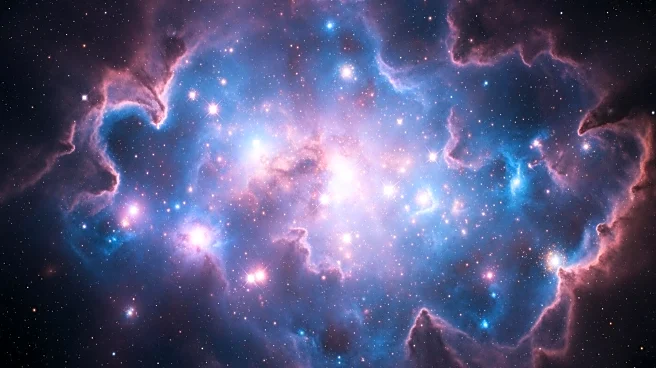
The Hubble Space Telescope has captured a striking image of the Lupus 3 molecular cloud, a star-forming region located approximately 500 light-years away in the constellation Scorpius. This region is notable
for the birth of T Tauri stars, which are young stars less than 10 million years old. These stars are in the early stages of their life cycle, characterized by dramatic variations in brightness as they evolve. The image reveals bluish fingers of gas and dust, where these young stars are forming, and highlights the blue reflection nebula known as GN 16.05.2 or Bernes 149. By observing in multiple wavelengths, Hubble can penetrate the dust to study the processes within molecular cloud complexes like Lupus 3, as well as other well-known regions such as Orion and the Eagle Nebula.
Why It's Important?
The discovery and imaging of the Lupus 3 molecular cloud provide significant insights into the processes of star formation, which are fundamental to understanding the origins of stars and planetary systems. T Tauri stars, which are rare in the Milky Way, offer a glimpse into the earliest stages of stellar development. The ability of the Hubble Telescope to observe these processes in detail helps refine astronomical models and theories about how stars and planets form. This research is crucial for advancing our knowledge of the universe and the conditions that lead to the formation of solar systems like our own.
What's Next?
Future observations and studies of the Lupus 3 molecular cloud and similar regions will continue to enhance our understanding of star formation. Astronomers may focus on the dynamics of T Tauri stars and the environmental factors influencing their development. Continued advancements in telescope technology and observational techniques will likely provide even more detailed insights into these processes, potentially leading to new discoveries about the lifecycle of stars and the formation of planetary systems.
Beyond the Headlines
The study of molecular clouds like Lupus 3 not only advances scientific knowledge but also raises questions about the broader implications of star formation in the universe. Understanding these processes can inform discussions about the potential for life elsewhere in the universe, as the conditions that lead to star and planet formation are also those that could support life. Additionally, the technological advancements required to study these distant regions drive innovation in observational astronomy and related fields.