
What's Happening?
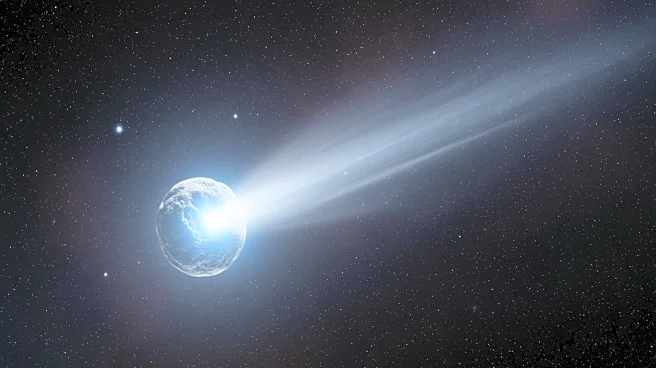
The Hubble Space Telescope and the Jupiter Icy Moons Explorer (Juice) have captured new images of the interstellar comet 3I/ATLAS as it nears its closest approach to Earth. Discovered in July, 3I/ATLAS is only
the third interstellar object observed passing through our solar system. The comet has intrigued astronomers due to its origin outside the solar system. Observations have been crucial in determining its trajectory and composition, particularly after gases sublimated from the comet during its closest pass by the sun in October. Hubble provided detailed views of the comet's teardrop shape, while Juice, en route to study Jupiter's moons, captured images showing a coma and two tails. The comet will come within 167 million miles of Earth on December 19, posing no risk to the planet.
Why It's Important?
The observation of 3I/ATLAS offers significant insights into interstellar objects, which are rare and provide unique opportunities to study materials from outside our solar system. Understanding the composition and behavior of such comets can enhance knowledge about the formation and evolution of celestial bodies. The data collected by Hubble and Juice could reveal more about the comet's origin and the processes affecting interstellar objects. This research contributes to broader scientific efforts to understand the universe's dynamics and the potential habitability of other celestial bodies, such as Jupiter's moons, which Juice is set to explore.
What's Next?
Juice's mission will continue as it travels to Jupiter, expected to arrive in July 2031. Meanwhile, the spacecraft will send back more data from its observations of 3I/ATLAS, including high-resolution images and composition data, between February 18 and 20. These findings may provide further clues about the comet's origin and characteristics. As 3I/ATLAS exits the solar system, astronomers will continue to analyze the data to enhance understanding of interstellar phenomena.