

What's Happening?
Archaeologists and volunteers are conducting an emergency excavation at the Nunalleq dig site near Quinhagak, Alaska, following significant damage from remnants of Typhoon Halong in October of last year. The storm caused widespread flooding and erosion,
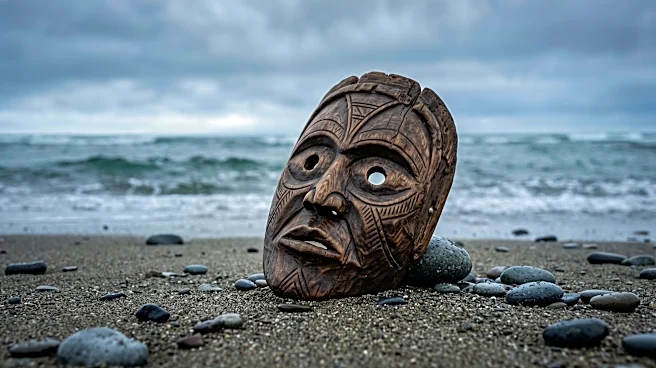
unearthing thousands of cultural objects from the site, which is renowned for preserving Alaska Native Yup'ik culture from 400 to 600 years ago. Jenny Matthew and her husband discovered a wooden bowl carved centuries ago, highlighting the extent of the artifacts scattered along the coastline. The storm not only dispersed existing artifacts but also increased the vulnerability of those still buried by eroding the land buffer between the Bering Sea and the archaeological site. Lead archaeologist Rick Knecht, who has been working at Nunalleq since 2009, described the situation as a race against time, comparing it to working 'in front of bulldozers.' The team, largely composed of volunteers and operating on a limited budget, is focused on recovering as many objects as possible before future storms cause further irreparable loss. The site contains well-preserved organic materials like hand-carved animals, grass rope, sewing needles, and ornate wooden masks, thanks to the frozen ground.
Why It's Important?
The emergency excavation at Nunalleq is critically important for the preservation of Alaska Native Yup'ik cultural heritage. The site offers a unique glimpse into pre-Western contact Yup'ik life, with artifacts dating back 400 to 600 years. These objects are not merely historical relics but are deeply interwoven into the identity and history of the Quinhagak community, providing a tangible link to their ancestors' resilience and ingenuity. The loss of these artifacts due to environmental factors, exacerbated by climate change, represents an irreplaceable loss of cultural knowledge and historical understanding. The efforts to recover and preserve these items are vital for future generations to connect with their heritage. Furthermore, the situation highlights the broader impact of climate change on archaeological sites globally, particularly in vulnerable coastal and permafrost regions. The erosion of shorelines and thawing permafrost, driven by human-caused climate change, poses a significant threat to countless historical and cultural sites, making the work at Nunalleq a case study in urgent cultural preservation.
What's Next?
The archaeological team hopes to return to the Nunalleq site next summer to continue their urgent preservation efforts. However, their ability to do so is contingent on securing additional funding, which they are actively raising through a GoFundMe campaign and Quinhagak Heritage Inc., the nonprofit overseeing the dig. With the fall storm season approaching, there is a heightened sense of urgency to recover as much as possible before another major weather event. The director of Quinhagak Heritage Inc., Elizabeth Church, emphasized the community's deep sense of responsibility to care for these ancestral belongings and integrate them into the future. The Nunalleq Culture and Archaeology Center serves as a repository for these artifacts, making them accessible to descendants and the public. The ongoing work will involve not only excavation but also the careful cataloging, preservation, and display of the recovered items, ensuring their long-term survival and educational value. The success of these fundraising efforts will determine the scope and continuity of future archaeological work at this critical site.
Beyond the Headlines
The situation at Nunalleq extends beyond immediate archaeological recovery, touching upon profound ethical and cultural dimensions. The community's decision to save these pieces of their culture, rather than allowing them to be lost to the elements, underscores the deep spiritual and historical connection between the Yup'ik people and their ancestral artifacts. The trauma experienced by community members upon seeing their heritage scattered by the storm highlights the emotional weight of cultural loss. This event also brings to the forefront the ethical responsibility of modern society to protect and respect indigenous heritage, especially when it is threatened by environmental changes largely driven by external factors. The resilience demonstrated by the Quinhagak community in actively participating in the preservation efforts, and their desire to learn from their ancestors' adaptability, offers a powerful narrative of cultural continuity in the face of adversity. The long-term implications include the potential for increased collaboration between indigenous communities and scientific institutions to develop sustainable strategies for cultural heritage preservation in a rapidly changing climate.