
What's Happening?
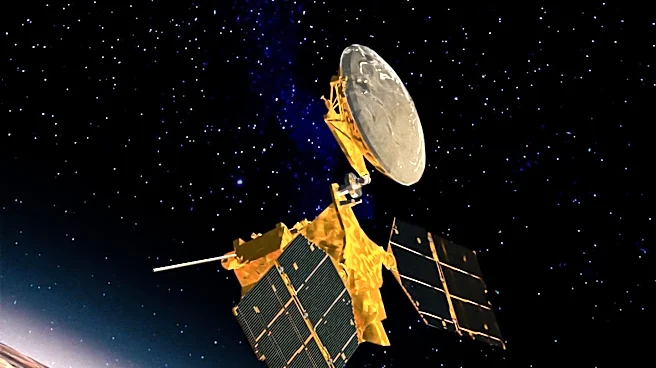
NASA's Psyche spacecraft recently completed a flyby of Mars, capturing a breathtaking timelapse of the Red Planet. On May 15, the spacecraft passed approximately 2,800 miles from Mars' surface, traveling at over 12,000 miles per hour. This maneuver served
as a 'dress rehearsal' for its ultimate mission to the asteroid Psyche, allowing the spacecraft to calibrate its sensors and gain a speed boost by using Mars' gravity. The flyby provided valuable data, including images of Mars' water-ice-rich south polar cap and the double-ringed Huygens crater, while also enhancing the spacecraft's trajectory towards its asteroid target.
Why It's Important?
The Psyche mission is groundbreaking as it aims to explore an asteroid composed primarily of metal, unlike any previously studied. The successful Mars flyby demonstrates the spacecraft's capabilities and sets the stage for its journey to the asteroid Psyche, which could provide insights into the building blocks of planets. Understanding the composition and characteristics of such asteroids can offer clues about the early solar system and the processes that led to planet formation. The mission also tests advanced technologies, such as deep space optical communication, which could revolutionize data transmission in future space missions.
What's Next?
Following the successful Mars flyby, the Psyche spacecraft is on course to reach its asteroid target by the summer of 2029. The mission will involve detailed studies of the asteroid's surface and composition using a suite of scientific instruments. These investigations aim to determine whether Psyche is the exposed core of a planetesimal, providing a unique opportunity to study the interior of a planetary body. The mission's findings could have significant implications for understanding planetary formation and the history of the solar system, potentially influencing future exploration strategies.