




What's Happening?
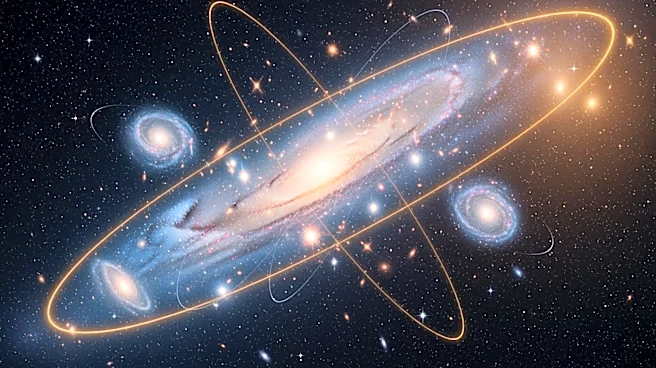
Recent observations of galaxy clusters have provided the largest-scale test of Newton's law of gravity, confirming its validity across vast cosmic distances. Researchers, including cosmologist Patricio Gallardo from the University of Pennsylvania, measured
the velocities of galaxy clusters billions of light-years away using the kinematic Sunyaev-Zeldovich effect. This method involves analyzing shifts in the cosmic microwave background (CMB) as it passes through moving galaxy clusters. The findings showed that gravitational forces between these clusters diminish with distance, consistent with Newton's and Einstein's theories. This supports the existence of dark matter as a more plausible explanation for the gravitational anomalies observed in the universe, rather than modifications to the laws of gravity.
Why It's Important?
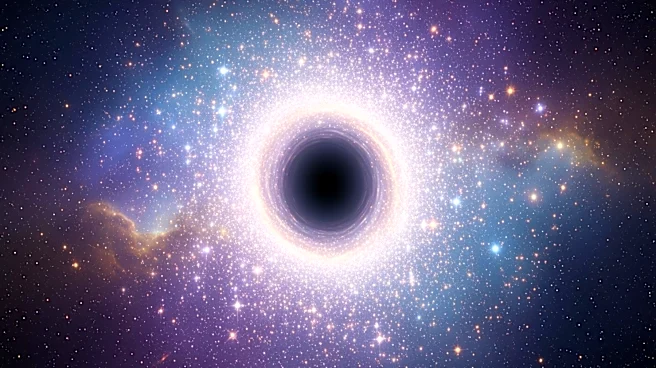
The confirmation of Newton's law of gravity on such a large scale strengthens the case for dark matter, a mysterious substance that constitutes approximately 85% of the universe's mass. Understanding dark matter is crucial for explaining why galaxies rotate faster than expected and why galaxy clusters remain bound together. This research narrows down the possibilities, suggesting that the universe's gravitational behavior aligns with established physics, thus focusing future research on identifying the nature of dark matter. The findings have significant implications for cosmology and physics, potentially guiding future explorations into the fundamental components of the universe.
What's Next?
The study's results encourage further investigation into the nature of dark matter, as the exact composition of this elusive substance remains unknown. Researchers may focus on developing new detection methods or refining existing ones to directly observe dark matter. Additionally, the study highlights the need for continued testing of gravitational theories at even larger scales and in different cosmic environments. These efforts could lead to breakthroughs in understanding the universe's structure and the fundamental forces that govern it.
Beyond the Headlines
The validation of Newton's law of gravity at such cosmic scales underscores the robustness of classical physics, even as it coexists with modern theories like general relativity. This research also highlights the ongoing challenge of reconciling quantum mechanics with gravitational theory, a key pursuit in theoretical physics. The study's implications extend to the philosophical realm, as it touches on the nature of reality and the limits of human understanding in comprehending the universe's vast complexities.